
TLDR
- The best way to teach Netrunner to a friend is to keep the first session narrow: one Runner deck, one Corp deck, simple tokens, and a clear explanation of what each side is trying to do.
- Do not start with the full rulebook, deckbuilding, formats, or every card type. Teach runs, servers, agendas, credits, clicks, ice, and icebreakers first.
- Use System Gateway starter decks, Learn-To-Play decks, or a simple printed teaching pair so the game starts quickly.
- Play with open hands for the first few turns if needed. The goal is understanding, not winning.
- After the first game, switch sides. Netrunner makes much more sense once both players feel the Corp and Runner pressures.
A bad first teach can make Netrunner feel like homework with card sleeves. A good one makes the game feel like what it actually is: a tense little argument between hidden information, pressure, money, and nerve.
That is why learning how to teach Netrunner to a friend matters. The rules are not impossible, but the first game can get clogged if you explain everything at once. You do not need to teach formats, deckbuilding theory, card legality, every damage type, every faction, and every timing window before the first run. Please do not. Your friend came to play a cyberpunk card game, not sit through a compliance seminar.
The trick is to teach the game in layers. Start with the table. Then the goal. Then the turn. Then the run. Everything else can wait.
Start With The One-Sentence Version
Before anyone draws a card, give your friend the clean version:
The Corp is trying to score 7 agenda points by protecting and advancing hidden agenda cards. The Runner is trying to steal 7 agenda points by breaking into the Corp’s servers.
That sentence does a lot of work. It explains why the game is asymmetrical. It explains why the Corp hides cards. It explains why the Runner makes runs. It also stops the first session from turning into a pile of disconnected terms.
After that, point to the table.
Say something like:
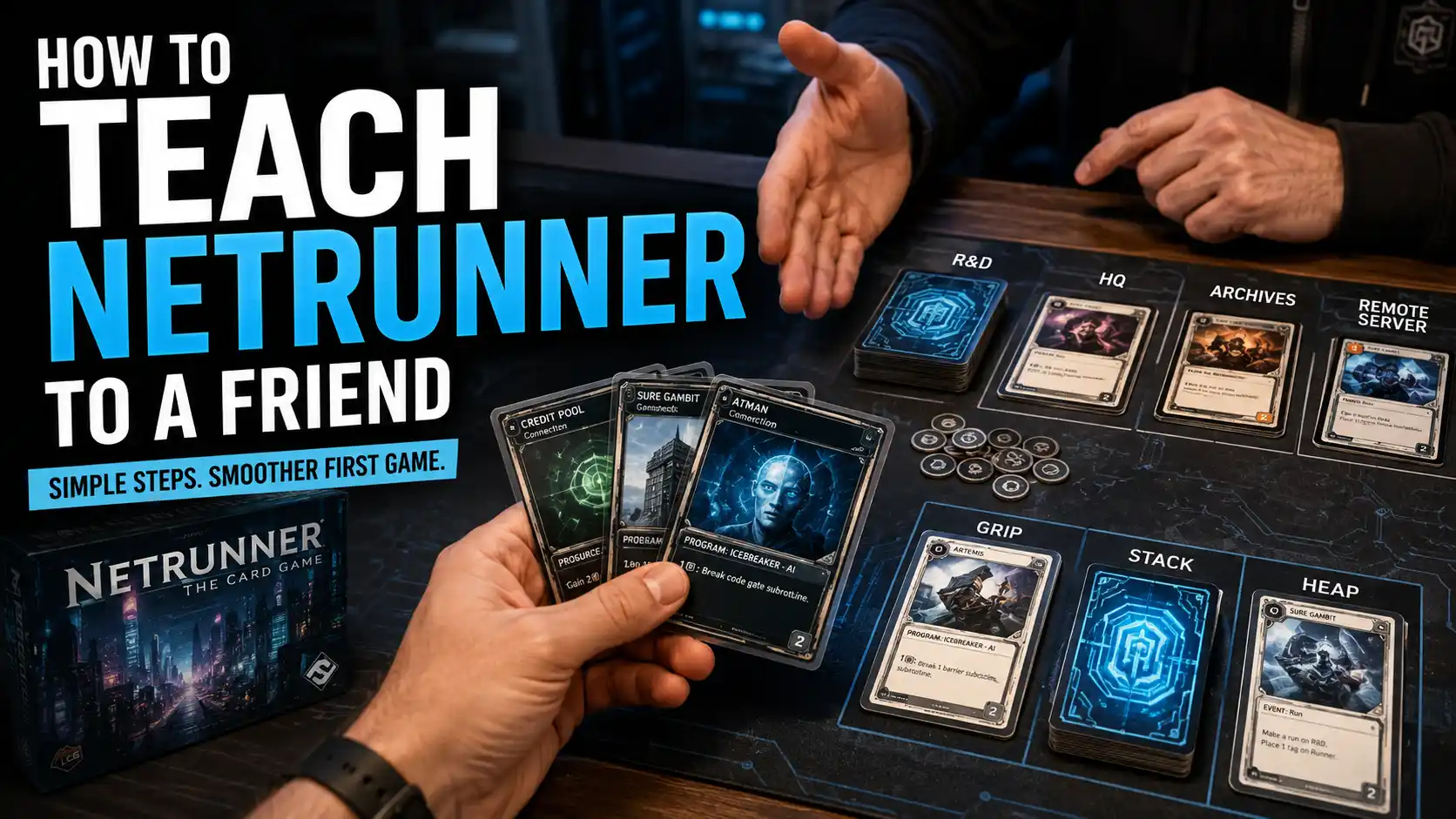
“The Corp has three main servers at the start: R&D is the deck, HQ is the hand, and Archives is the discard pile. The Corp can also build remote servers during the game. The Runner attacks those servers.”
That is enough to begin.
Do not explain every possible server interaction yet. Do not explain weird edge cases. Do not open the comprehensive rules. The first goal is simple: your friend should know where to run and why running matters.
Use The Right Teaching Decks
The easiest teaching setup is a matched pair of decks built for new players. System Gateway is the cleanest official starting point because it was made to teach the game and then move into basic deckbuilding. It gives new players a real first structure without asking them to build from a huge card pool.
You can also use dedicated Learn-To-Play decks or a printed teaching pair if you want something ready for repeat demos. A good teaching pair should have:
- clear economy cards
- straightforward agendas
- simple ice
- a few icebreakers
- one or two exciting cards, but not too many
- no giant pile of mechanics that need their own lecture
That last point matters. Beginner decks should not be boring, but they should be controlled. You want the new player to see the fun parts of Netrunner without asking them to process twelve mechanics before lunch.
If you are building or printing your own teaching setup, do not start by copying tournament decks. Tournament decks are often tuned for people who already understand the pressure points. A beginner deck should show the shape of the game. It should not punish someone for not knowing the meta.
For a paper setup, a dedicated pair of printed decks is useful because you can keep them intact. That means no hunting through a box for missing cards, no “hold on, I need to rebuild the Corp deck,” and no accidental deckbuilding puzzle before the first turn. If you want that kind of setup, a Netrunner deck printing service can be useful for building a clean teaching kit.
Teach The Table Before You Teach The Cards
New players often get lost because they are reading cards before they understand the table. That is backwards.
Explain the zones first:
For the Corp:
- R&D is the Corp deck.
- HQ is the Corp hand.
- Archives is the Corp discard pile.
- Remote servers are built during the game.
- Ice protects servers.
For the Runner:
- Stack is the Runner deck.
- Grip is the Runner hand.
- Heap is the Runner discard pile.
- The Runner installs cards faceup.
- The Runner makes runs to access Corp cards.
That is the foundation. Once your friend understands the table, the cards have somewhere to live in their brain.
Then explain clicks and credits.
Clicks are actions. Credits are money. The Corp usually gets 3 clicks and a mandatory draw. The Runner usually gets 4 clicks and no mandatory draw. That difference is one of those small rules that quietly explains a lot. Corp is managing hidden cards and tempo. Runner is choosing when to build and when to attack.
You can teach the basic actions as they come up. Draw a card. Gain a credit. Install a card. Make a run. Play an event or operation. Advance an agenda. Keep it practical.
Walk Through The First Run Slowly
The first run is the moment Netrunner either clicks or turns into soup.
Slow down here.
Set up a simple remote server with one piece of ice in front of it. Have the Runner run the remote. Then walk through the run in plain English:
“The Runner chooses the server. The Corp can rez the ice by paying its rez cost. If the ice is rezzed, the Runner encounters it. If the Runner cannot break the subroutines, the subroutines happen.”
Use a simple piece of ice first. Something that ends the run is ideal because it teaches the point clearly. The Runner tried to get in. The Corp paid money to defend. The run ended.
That is a complete little story.
On the next run, introduce an icebreaker. Show that the Runner needs the right type of breaker, enough strength, and enough credits to break the relevant subroutines. This is the part where many new players start to understand why money matters so much. Credits are not just points in a pile. Credits are options.
A simple teaching line works well:
“Ice is the lock. Icebreakers are the tools. Credits are what let the tools actually work.”
Not every ice needs to be explained at once. Barriers, code gates, and sentries can come later, after the player sees why breaking ice matters.
Let Them Play With Open Hands At First
Open hands feel wrong to experienced players because hidden information is such a big part of Netrunner. But for a first teaching game, open hands can help.
The new player is already learning servers, runs, clicks, credits, agendas, ice, and access. They do not need to also guess what every facedown card might be before they understand what a facedown card can be.
You can use open hands for the first few turns, then switch to normal hidden information once the basic rhythm is clear.
This works especially well if you are teaching one person and playing against them. Talk through your Corp choices:
“I am installing this card in a remote because I want to score it later.”
“I am putting ice in front of HQ because I have agendas in hand.”
“I am not rezzing this ice yet because I want to save credits.”
That kind of narration teaches more than a rules dump. It shows the reason behind the actions.
If you are teaching two new players at once, let them play each other while you coach both sides. That keeps the game from feeling like the experienced player is just steering one person into mistakes.
Do Not Teach Deckbuilding Yet
Deckbuilding is one of the best parts of Netrunner. It is also a terrible first stop for most new players.
A new player who has not made a few runs yet cannot really judge whether a card is good. They do not know what a scoring window feels like. They do not know why ice density matters, why economy needs redundancy, or why the Runner cannot just install every cool program in the deck.
So keep deckbuilding out of the first session.
Use this order instead:
- Play a scripted or guided first game.
- Play a second game with less help.
- Switch sides.
- Talk about what felt confusing.
- Only then look at changing cards.
This keeps the first lesson focused on the game itself. Deckbuilding becomes a reward for understanding, not a barrier to entry.
Explain Winning Without Overexplaining Every Win Condition
For the first game, focus on agenda points.
The Corp scores agendas. The Runner steals agendas. First to the required agenda point total wins.
You can mention flatline once, especially if a damage card appears. But do not turn the first session into a full lecture on damage math, tags, meat damage, net damage, core damage, and all the ways a Runner can get punished. Teach the immediate danger when it matters.
A useful line is:
“Most games are about agenda points, but the Corp can also win by dealing enough damage to flatline the Runner.”
That is enough at first.
The empty R&D loss can also wait unless it comes up. It is real, but it is not usually the thing a new player needs in the first ten minutes.
Keep The First Game Short
A teaching game should not be a marathon. If the first game takes forever, the new player may assume Netrunner always feels that slow.
Shorter teaching games work better because they let both players reset, switch sides, and try again while the first lesson is still fresh.
That is one reason beginner setups often use smaller decks or guided scripts. They create more predictable teaching moments. The important cards show up. The first run happens. The first agenda matters. The first icebreaker teaches its lesson. The game has shape.
If a game gets bogged down, it is fine to pause and reset.
Say:
“Let’s stop here and switch sides. You’ve seen the basic run structure now, and it will make more sense from the other seat.”
That is not failure. That is good teaching.
Switch Sides Early
Netrunner is hard to understand from only one chair.
A Runner who never plays Corp may not understand why HQ pressure is scary. A Corp who never plays Runner may not understand how awful it feels to face a remote you cannot afford to check.
Switching sides early solves this faster than explaining it for twenty minutes.
After the first game, have your friend play the other side. Do not change decks yet. Keep the variables low. The same matchup from the other seat teaches a lot.
They will start to notice:
- why the Corp protects central servers
- why the Runner pokes R&D
- why credits change every decision
- why a remote server can be a real agenda or a trap
- why one wasted turn can matter
This is where Netrunner starts feeling less like rules and more like pressure.
Common Mistakes When Teaching Netrunner
The biggest mistake is explaining too much too early. Experienced players love context. New players need traction.
The second mistake is using decks that are too clever. A deck can be balanced and still be a bad teaching deck if it wins through interactions the new player cannot see.
The third mistake is treating the first game like a real match. It is not. The first game is a demo with stakes. Winning is less important than showing how the game breathes.
The fourth mistake is correcting every small sequencing issue immediately. Some corrections matter. Others can wait. If the new player makes a choice that is legal but not optimal, let it happen sometimes. They will learn more from seeing the result than from being stopped every thirty seconds.
The fifth mistake is teaching from the comprehensive rules instead of the table. The full rules are useful later. For a first game, they are usually too much.
A Simple First Session Plan
Here is a clean structure for teaching Netrunner to a friend:
- Give the one-sentence goal.
- Show the Corp servers and Runner zones.
- Explain clicks and credits.
- Play the first Corp turn slowly.
- Walk through the first Runner run.
- Introduce ice and icebreakers through play.
- Keep hands open if the player is struggling.
- Finish the game or stop once the core rhythm is clear.
- Switch sides.
- Save deckbuilding and format talk for later.
That structure is simple on purpose. Netrunner already has plenty going on. The teach should make the game smaller until the new player has enough grip to handle more.
What To Do After The First Game
After the first game, ask three questions:
“What made sense?”
“What felt confusing?”
“Which side did you want to try again?”
Those questions are better than immediately explaining what they did wrong. They also tell you what to teach next.
If they liked running, show them how pressure works. If they liked Corp, explain scoring windows. If they were confused by ice, play a short sequence with one barrier, one code gate, and one sentry. If they liked the game but felt lost, play the same decks again and switch sides.
Then, once they have a few games in, point them toward NetrunnerDB, Startup decklists, or a small printed card pool. At that point, new cards will feel exciting instead of random.
FAQs
What Is The Best Way To Teach Netrunner To A Friend?
The best way to teach Netrunner to a friend is to use a simple paired deck setup, explain the Corp and Runner goals first, and teach the run structure through play. Do not start with full deckbuilding or the comprehensive rules.
Should A New Player Start As Runner Or Corp?
Runner is often easier emotionally because the Runner takes proactive actions and sees more of the game through runs. But both sides matter. Let the new player try Runner first if they want, then switch sides soon after.
Should We Use Open Hands In A First Teaching Game?
Yes, open hands can help during the first few turns. It removes some hidden-information pressure while the new player learns servers, clicks, credits, ice, and runs. Switch to normal hidden hands once the basic flow makes sense.
Are System Gateway Decks Good For Teaching Netrunner?
Yes. System Gateway is built as a beginner-friendly foundation and includes teaching decks plus cards for early deckbuilding. It is a much cleaner starting point than random older products or tournament lists.
When Should New Players Start Building Decks?
Wait until they have played a few games on both sides. Deckbuilding makes more sense once a player understands runs, scoring windows, economy, ice, and pressure.
Conclusion
Teaching Netrunner well is mostly about restraint.
Start with the goal. Show the table. Teach one run. Let the new player feel why credits matter, why ice matters, and why hidden cards make every decision tense. Then switch sides and do it again.
You do not need to explain the whole game at once. In fact, you should not. Netrunner gets better as the layers reveal themselves. A good first teach gives your friend enough structure to play, enough mystery to stay curious, and enough momentum to ask for another game.
That is the win.