
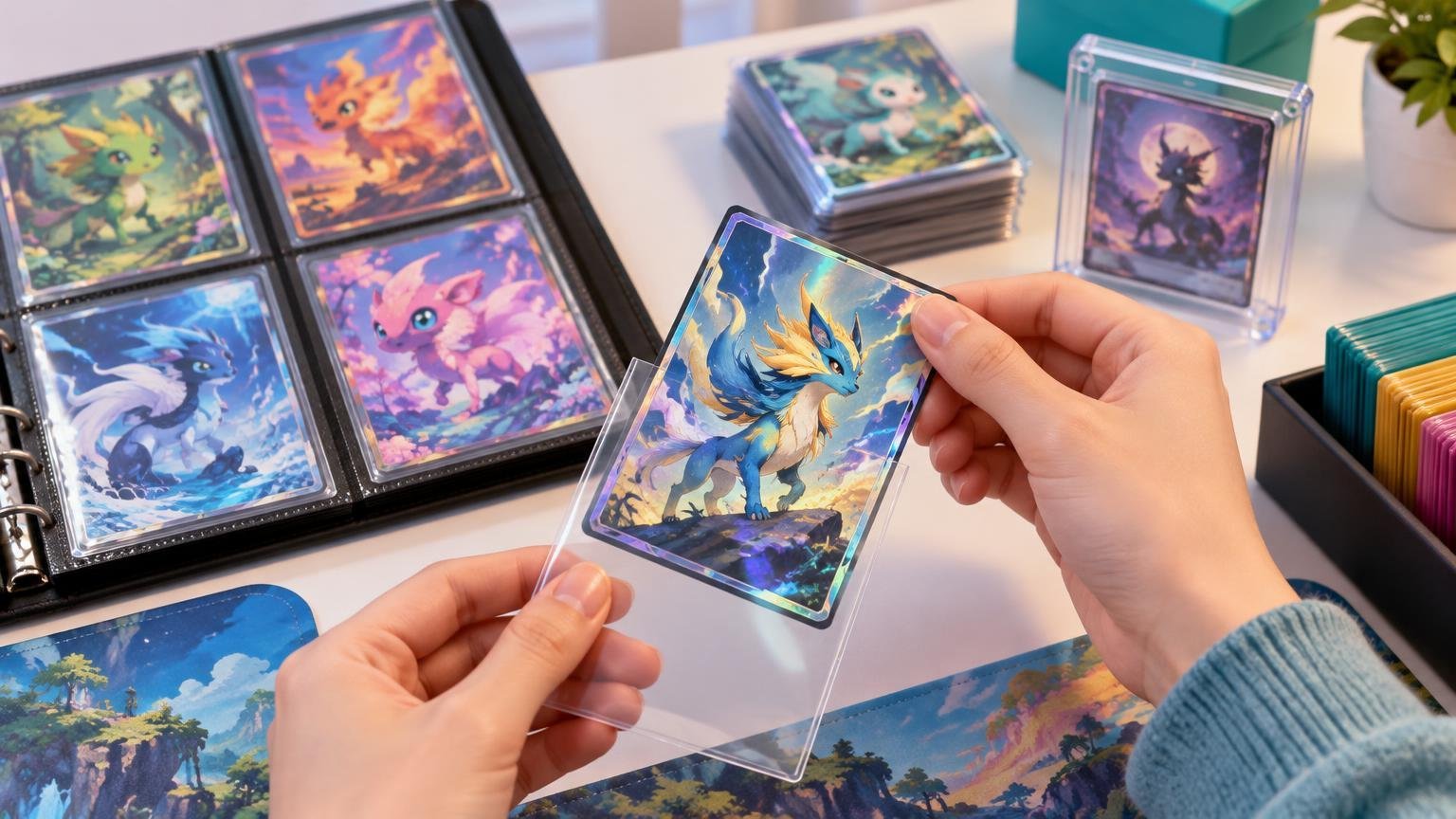
TLDR: To protect holographic custom pokemon cards, place each card in a clean, correctly sized sleeve before it goes into a binder, rigid holder, deck box, or storage box. Keep cards away from direct sunlight, heat, damp rooms, vents, heavy stacks, food, and drinks. Handle them by the edges over a clean surface, and do not apply cleaning liquids or aggressively polish an undocumented specialty finish.
Holographic surfaces make fingerprints, scuffs, and fine scratches easy to notice. The safest routine is simple: reduce direct contact, prevent cards from rubbing against one another, avoid concentrated pressure, and maintain a stable indoor storage environment. That approach helps protect holographic custom pokemon cards without making assumptions about the particular film, coating, ink, or adhesive used to create their finish.
Start with one sleeve for every card
An individual sleeve is the first protective layer because it prevents the card face from rubbing directly against a binder pocket, rigid holder, neighboring card, or tabletop. Choose a sleeve that accepts the card without forcing it. The card should slide in smoothly and sit flat rather than bowing against tight edges.
Use one card per sleeve. Putting two cards together creates extra pressure and allows the surfaces to rub when the cards move. Before inserting a card, inspect the sleeve for dust, grit, bent corners, or a rough seam. A tiny particle trapped against a reflective surface can become an abrasion point whenever the sleeve is handled.
Replace a sleeve when it becomes visibly dirty, cloudy, creased, or rough. When removing the card, open the sleeve gently and let the card slide out instead of pinching its faces. For a played deck, use sleeves with consistent backs and similar wear so individual cards cannot be distinguished during a game.
Match the storage method to how you use the card
| Use case | Practical storage choice | Main precaution |
|---|---|---|
| Casual deck or Cube play | Individual sleeves in a correctly sized deck box | Limit movement inside the box and replace damaged sleeves |
| Binder collection | One sleeved card per properly fitting pocket | Do not force cards into pockets or overfill the binder |
| Individual display or transport | Sleeve inside a compatible rigid or semi-rigid holder | Check the holder for debris and avoid heavy stacks |
| Longer-term boxed storage | Sleeved cards stored upright in a fitted card box | Keep the box indoors, dry, supported, and away from heat or sunlight |
Binder storage
A binder works well for cards you want to browse, but every pocket should hold only what it was designed to accommodate. Do not double up cards, force thick combinations into tight pockets, or keep adding pages until the binder bulges. Inspect pockets before use because debris inside a page can sit directly against the sleeve.
Store binders upright with enough support to prevent slumping. Avoid piling heavy books or additional binders on top. Concentrated weight can press cards against rings, seams, page edges, or trapped particles. The broader Pokémon card storage guide also covers binder loading, toploaders, bending, scratches, and fading in more detail.
Rigid and semi-rigid holders
Sleeve a holographic card before placing it in a rigid holder. The sleeve reduces direct contact with the holder and makes removal less abrasive. Check that the combined card-and-sleeve thickness fits comfortably; a holder that requires force is not a good match.
Rigid holders are useful for individual display and transport, but they do not make pressure irrelevant. Store loaded holders upright in a fitted box when practical. Avoid an unstable flat tower or placing heavy objects on top, especially when the holders can slide against one another.
Control humidity, heat, and stacking pressure
Custom holographic cards can use different stocks and finish constructions, so no single humidity number guarantees that every card will remain flat. The reviewed PokémonProxy product information identifies handmade holographic cards printed on black-core stock, but it does not document the exact holographic film, coating, adhesive, or cleaning requirements.
The useful rule is to favor stability. Keep cards in a clean indoor room that stays relatively cool and dry. Avoid cars, attics, garages, damp basements, windowsills, radiators, and heating or air-conditioning vents. Moving cards repeatedly between hot, cold, damp, and dry conditions is an unnecessary preservation risk.
The Library of Congress guidance for works on paper recommends a stable environment at room temperature or cooler, relatively dry conditions, and protection from direct or intense light. It offers roughly 35% relative humidity as a paper-preservation benchmark, but that is not a product-specific promise that a custom holographic card will remain unchanged at that exact level.
If cards begin to curl, do not try to correct them with extreme heat, moisture, or a crushing stack of books. Move them to a stable indoor environment, keep them supported in suitable sleeves and storage, and seek maker-specific advice before attempting an active treatment.
Keep holographic cards out of direct sunlight
Do not leave holographic custom cards in direct sun or under intense display lighting. A sunny window can combine light exposure with changing heat, making it a poor long-term display location.
UV-filtering display materials can reduce ultraviolet exposure, but they do not eliminate every light-related risk. The Library of Congress notes that filtering ultraviolet radiation removes the most damaging part of sunlight while also warning that all light can damage paper over time. Rotate displayed cards, reduce exposure time, and keep important pieces away from direct or intense light even when the display advertises UV filtering.
Handle specialty finishes without creating abrasion
Wash and dry your hands before handling cards, clear the work area, and keep food and drinks elsewhere. The Library of Congress identifies clean hands, clean work areas, protective enclosures, and separation from food and beverages as practical measures for paper-based collections.
Hold a card by its edges where practical. Set it down only on a clean, smooth surface, not unfinished wood, gritty fabric, adhesive mats, or an area where sleeves have collected crumbs and dust. Avoid repeatedly sliding the card across a table, even while sleeved.
Treat fingerprints cautiously. Without finish-specific instructions from the maker, do not use household cleaners, alcohol, adhesive removers, polish, or an aggressive wiping motion. These could interact unpredictably with an undocumented coating or printed layer. If a mark cannot be removed with minimal handling, leaving it alone may be safer than turning a fingerprint into a permanent scuff.
Keep custom cards distinct from authentic cards
Protection is not only about physical condition. Unofficial custom and proxy cards should remain easy to distinguish from genuine Pokémon cards, especially when a collection is moved, traded, or handed to another person.
Use labeled binder sections, dividers, or separate storage boxes. Preserve any proxy or custom markings rather than covering or trimming them. The checklist for clearly marked Pokémon proxy cards explains how labeling, organization, and disclosure can reduce confusion during casual play. The related guide to the difference between a Pokémon proxy and a fake card covers why honest presentation matters when cards change hands.
Check current rules before taking proxies to an event
Storage choices do not determine event eligibility. Before taking a custom or proxy card to an organized event, consult the current Pokémon TCG Tournament Handbook and ask the event organizer if anything remains unclear. The official Play! Pokémon resources and documents hub provides access to the published handbook. Pokémon also announced a rules-and-resources update for Q1 2026, which is a reminder that old summaries may not reflect the currently published language.
Quick protection checklist
- Use one clean, correctly sized sleeve per card.
- Inspect sleeves, binder pockets, and rigid holders for debris before insertion.
- Do not force cards into tight sleeves or overloaded binder pockets.
- Store binders and loaded holders upright and supported.
- Use fitted deck or storage boxes that limit unnecessary movement.
- Keep cards away from direct sunlight, intense light, heaters, vents, damp rooms, and hot vehicles.
- Avoid heavy stacks and objects that create concentrated pressure.
- Handle cards by the edges over a clean, smooth surface.
- Keep food, drinks, tape, adhesives, and cleaning fluids away.
- Label and separate unofficial custom cards from authentic cards.
Common protection questions
Can a sleeved holographic card go in a binder?
Yes, provided the sleeved card fits the pocket without force. Use one card per pocket, avoid overfilling the binder, and inspect the page for dust or damaged seams.
Is a binder or rigid holder better?
A binder is convenient for browsing a collection. A compatible rigid holder provides more structural support for an individual card during display or transport. Neither option replaces a sleeve, careful handling, or sensible environmental storage.
Can humidity contribute to curling?
Moisture and environmental instability are preservation concerns for paper-based objects, but custom card constructions differ. Prioritize a stable, relatively dry indoor environment rather than relying on a supposedly universal humidity setting.
Is it safe to stack binders?
Avoid heavy flat stacks. Weight can create uneven pressure through covers, rings, seams, and overfilled pages. Upright, supported storage is the more conservative approach.
Build protection around the card’s real use
For playable cards, prioritize clean sleeves, a fitted deck box, and regular sleeve replacement. For binder collections, control pocket pressure and store the binder upright. For display cards, combine a sleeve with a compatible holder while limiting light exposure. Across every use case, stable storage and low-friction handling matter more than elaborate accessories. Start by sleeving each card individually, then remove the biggest risk in its current location: sunlight, moisture, movement, debris, or stacking pressure.
References
- How To Store Pokemon Cards Without Bending, Scratching, Or Fading Them – pokemonproxy.co
- Gold Star Set Of Five Holographic Custom Made Pokemon Proxy Card – pokemonproxy.co
- Care, Handling and Storage of Works on Paper – Collections Care (Preservation, Library of Congress)
- Paper – FAQ – About (Preservation, Library of Congress)
- Play! Pokémon Resources and Documents
- Play! Pokémon Rules and Resources Updated for Q1 2026