
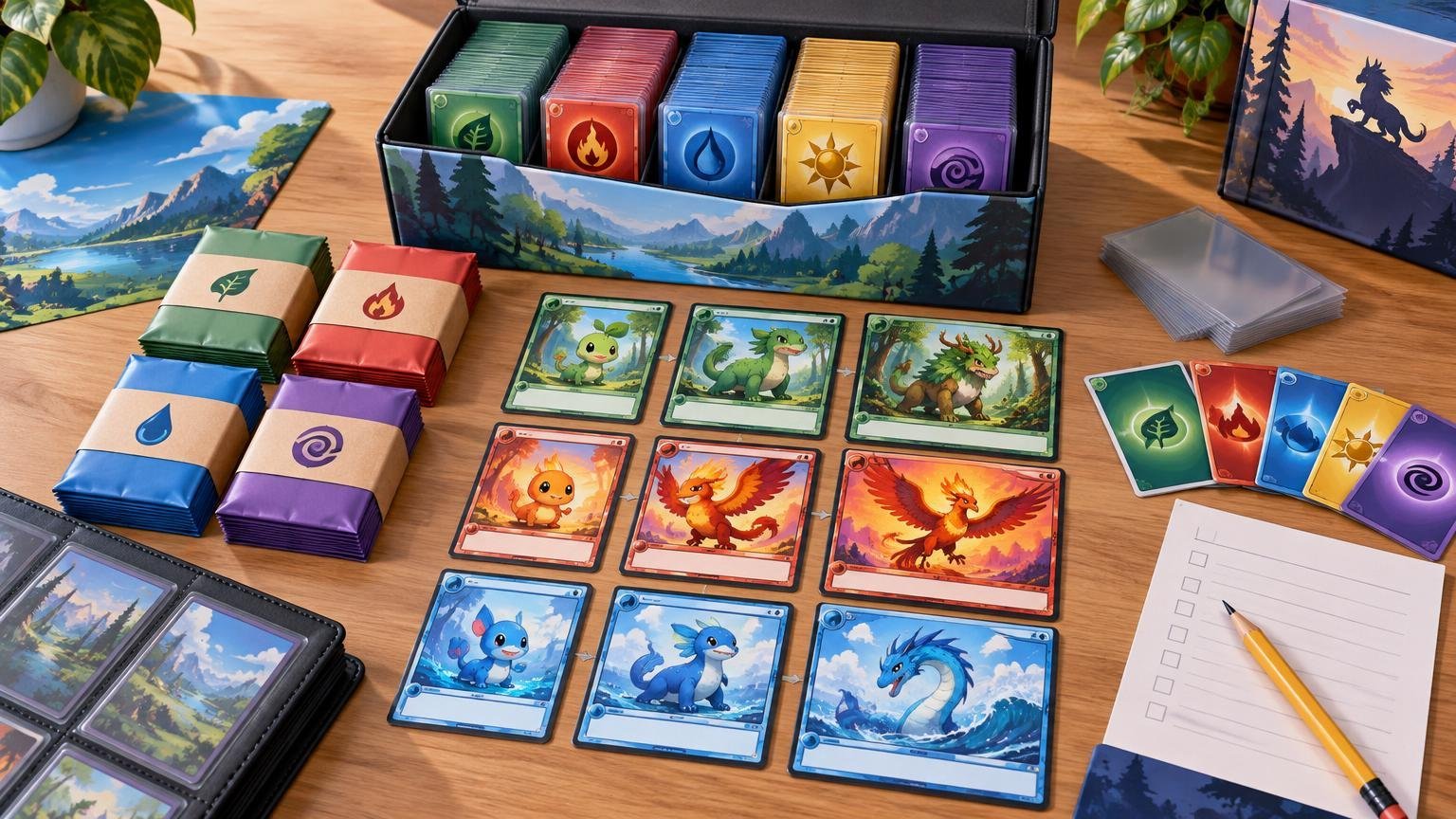
TLDR: A pokemon set cube is a reusable card pool designed to recreate the Limited environment of one Pokémon expansion. It does not have to contain one copy of every card. A good build uses deliberate duplicate counts, pack construction, Evolution support, and enough Trainers and Energy access to make the set’s intended strategies function. Start with proxies, test several drafts, and buy genuine copies only after the list is stable.
Building a pokemon set cube is less like completing a binder and more like remastering a game environment. You choose one expansion, assemble reusable homemade packs, draft them, and return the cards to the Cube afterward. The difficult part is deciding how closely to copy the original product when exact rarity distribution or weak Evolution access would produce frustrating games.
What counts as a Pokémon set cube?
A regular Pokémon Cube can combine cards from many eras around chosen mechanics or archetypes. A set cube begins with one expansion and tries to preserve that set’s identity. The official Pokémon Cube feature describes a Cube as a selected, self-contained pool from which players draft and build decks. It also demonstrates that creators can define their own structure and rules rather than reproducing sealed products exactly. Pokémon’s official Cube feature
Choose one of three goals before making a list:
- Strict recreation: Use only cards from the expansion and approximate its original rarity structure as closely as practical.
- Set-inspired Cube: Keep the expansion’s Pokémon and major themes, but add outside Trainers, Energy cards, or Evolution support where necessary.
- Playable remaster: Adjust quantities, remove consistently poor cards, and strengthen weak archetypes to create the best repeatable draft environment.
None of these approaches is inherently correct. A historical project should preserve more quirks. A Cube intended for monthly game nights can prioritize balanced choices and reliable setup. Label a modified list as set-inspired or remastered so players know it is not a literal reconstruction.
Write the design brief before buying cards
Record the chosen expansion, language or printing, player count, deck size, Prize count, pack structure, Energy policy, and permitted outside cards. For an older set, also decide whether to use its original wording and rules era or current card text and rulings. Verify card-specific errata and historical mechanics rather than relying on memory.
This brief prevents a common problem: changing several variables after every draft without knowing which change fixed anything. House rules are fine, but they should be short, visible, and consistent across sessions.
How many cards should a set cube contain?
Begin with the cards consumed by one draft: players × packs per player × cards per pack. For eight players opening three homemade 10-card packs, the session needs 240 draftable cards. That is a planning calculation, not an official Pokémon requirement.
The Cube may be exactly that size, but a larger pool improves variation because each session can leave some cards unused. Pokémon’s published Hisui Cube is a 540-card bespoke environment for eight players, and its design explicitly allows cards to remain out of a particular draft. That example shows how much flexibility Cube designers have; it is not a recommended size for every set cube.
A compact pool is easier to balance and makes supported archetypes appear consistently. A larger pool creates discovery and replay value, but it can strand Evolution pieces or dilute narrow strategies. Build the smallest version that supports your planned draft, then expand only when repeated drafts feel too predictable.
Choose a homemade pack method
Pack construction changes the environment as much as the master list. Use one of these methods:
| Method | How it works | Best use | Main tradeoff |
|---|---|---|---|
| Fully randomized | Shuffle the pool and deal equal packs | Fast prototypes | Rarity and Evolution access can swing sharply |
| Rarity-slot packs | Deal defined common, uncommon, rare, and flexible slots | Capturing a release-era feel | Requires sorting and careful quantity planning |
| Functional collation | Guarantee broad roles such as Pokémon, Trainers, or Evolution access | Dependable gameplay | Feels less like opening original boosters |
Fully random packs are ideal for the first test because they expose weaknesses quickly. Once the card pool works, rarity-slot packs can add more of the desired booster feel. Functional collation is useful when authenticity repeatedly produces non-games.
Treat rarity as an experience, not a command
Rarity simulation should make powerful or unusual cards feel special without preventing decks from functioning. You can preserve a rare card’s scarcity while including several copies of a common Basic that multiple Evolution lines require. Cube quantities do not need to match a complete set checklist.
Track each card with the following fields: card name, quantity, printed rarity, homemade pack slot, archetype role, Evolution line, and revision notes. That worksheet reveals when an archetype appears to have ten cards but actually depends on one scarce Basic or one irreplaceable Trainer.
Duplicates are not a flaw in a Pokémon Cube. They are a design tool. Increase copies of cards that connect the environment, enable Evolution lines, or provide general setup. Keep narrow finishers and dominant effects scarcer unless testing shows that their decks cannot come together.
Evolution support is the central design problem
A Stage 2 may look exciting in a pack, but it is not a meaningful pick if its Basic and Stage 1 are unlikely to appear. Count complete pathways rather than individual Pokémon. Then draft the Cube repeatedly and note how often those pieces reach the same player.
Useful fixes include increasing Basic counts, adding more Stage 1 copies, supplying starter-line packages before the draft, adding suitable search cards, or using a clearly documented Evolution house rule. Pokémon’s official Cube example uses a pre-draft starter-line system, showing that structural support can be part of the format rather than hidden inside pack luck.
Make one adjustment at a time. If you simultaneously double every Basic, add universal search, and change Evolution rules, it becomes difficult to identify what the environment actually needed.
Add the support layer the set needs
Check whether the source expansion provides enough draw, search, switching, recovery, and Energy access for your chosen deck size. Flexible support cards keep drafters involved even when they do not open a perfect Evolution line.
Adding Trainers from another expansion is reasonable when gameplay matters more than strict historical accuracy. It changes the project from set-only to set-inspired, however, and that distinction should appear in the design brief. Prefer support that helps several strategies rather than importing a powerful engine that overwhelms the set’s original identity.
Basic Energy is usually easiest to provide as an unlimited shared supply outside the draft. Special Energy can remain draftable when access to it creates a meaningful deckbuilding choice. If an archetype cannot operate without one specific Special Energy, increase access or reconsider whether scarcity improves the format.
Do Cube decks need 40 or 60 cards?
There is no automatic deck size for a private Cube. Normal constructed Pokémon decks contain exactly 60 cards, generally allow no more than four cards with the same name other than Basic Energy, and require at least one Basic Pokémon. Those are constructed standards, not mandatory Cube-design rules. Read the official Pokémon TCG rulebook
Many groups choose smaller decks and fewer Prize cards because the draft pool cannot provide the consistency of a constructed collection. Whatever you choose, state it before drafting. Also decide whether Cube decks have a copy limit. Enforcing the normal four-copy limit may be irrelevant if no drafter can realistically acquire five copies, while a duplicate-heavy Cube may need an explicit rule.
Use proxies to solve cost and scarcity before committing
Proxies are most useful during development. They let you test extra copies of scarce vintage Basics, expensive rares, alternate Trainer packages, and different pack ratios without buying each version of an unfinished list. The existing guide to building a Pokémon TCG Cube with proxies covers the broader Cube workflow, while the paper inserts versus full-card proxies comparison can help with prototype choices.
Start with inexpensive, clearly marked placeholders. Replace them with more durable proxies or genuine cards only after their quantities survive several drafts. A premium-looking card does not fix a bad slot, and buying the authentic version too early can make it emotionally harder to remove a card that is hurting the environment.
Keep every unofficial card recognizable and obtain group agreement before play. Never present a proxy as authentic; the casual-play marking checklist offers practical ways to prevent confusion. A private Cube is separate from sanctioned competition, so consult current Play! Pokémon rules and resources for event requirements rather than assuming your Cube rules or materials carry over.
Review the environment after every draft
Do not rebalance from one dramatic game alone. Collect the same observations from several players, then revise a small batch of cards.
- Could players establish a Basic Pokémon and begin executing a plan?
- How often did drafted Evolutions connect into complete lines?
- Which advertised archetypes appeared, and which never came together?
- Which cards always wheeled around the table without being selected?
- Which cards were automatic first picks regardless of deck direction?
- Did games turn on interesting decisions or mostly on setup variance?
- Were Trainers, switching effects, and Energy available in useful amounts?
- Did the homemade pack method create the intended rarity tension?
Cube testing commonly reveals dead archetypes, overdrafted Trainers, stranded Evolutions, and cards that perform much better than expected. Change quantities or collation first; remove an archetype only after simpler support fixes fail.
Build the first version, not the final version
The best first pokemon set cube is a playable hypothesis. Choose whether you value historical accuracy or replayability, calculate one draft’s card requirement, support complete Evolution lines, and provide a sensible Energy policy. Prototype the uncertain slots with recognizable proxies, draft the pool, and record what actually happens.
After a few sessions, you will know which rare cards deserve more access, which Evolution pieces need duplication, and which outside support cards genuinely improve the set. That measured revision process is what turns a box of cards from one expansion into a Limited environment worth drafting repeatedly.