
TLDR
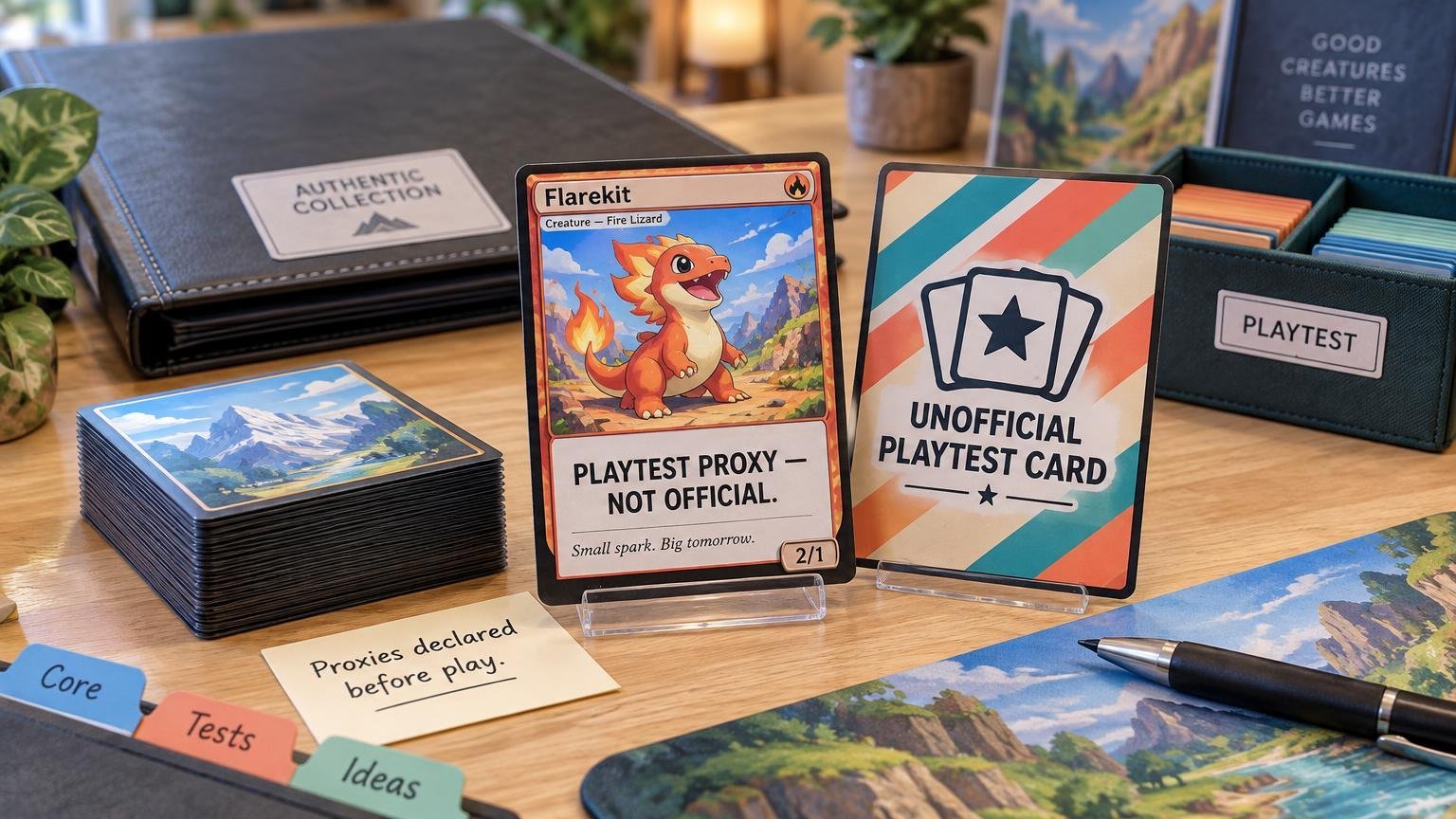
Clearly marked pokemon proxy cards should be identifiable as unofficial in three situations: during a game, after they leave their sleeves, and while they are stored. Use a prominent front label, an unmistakably custom back, and at least one secondary cue such as a watermark, altered frame, project code, or original artwork. Keep proxies in labeled storage, use consistent opaque sleeves during play, and tell everyone at the table before the game begins. Never assume that permission in a casual group carries over to a store, League, or sanctioned event.
The goal is not merely to make a proxy look different under close inspection. A good marking system prevents an unofficial card from being mistaken for an authentic card when someone sorts a deck, opens a box months later, or handles the card outside its sleeve. The clearest approach uses redundant signals rather than relying on one tiny disclaimer.
What clearly marked Pokémon proxy cards need
An effective proxy marking system has three layers. The front identifies the card without hiding information needed to play. The back makes its unofficial status obvious outside a sleeve. Storage labels preserve that distinction after the game. If one layer is missed, the others still communicate what the card is.
| Identification layer | Practical treatment | Why it matters |
|---|---|---|
| Front | Readable PROXY or PLAYTEST label in a consistent location | Players can identify it without removing it from a sleeve |
| Back | Custom graphic plus CASUAL ONLY, PROXY, or similar text | The loose card cannot be confused with an authentic card back |
| Secondary cue | Watermark, altered frame, border color, icon, or project code | Reinforces the label and helps organize large pools |
| Storage | Dedicated box, divider, envelope, or inventory entry | Reduces accidental mixing with authentic collections |
| Communication | Disclosure before shuffling | Lets the opponent or host decide whether the cards fit the session |
Start with an unmistakably unofficial back
A custom back is one of the strongest identifiers because it remains visible when the card is out of its sleeve. Avoid reproducing an official-style back as closely as possible. Use an original graphic and large, direct wording such as PROXY, PLAYTEST CARD, CASUAL ONLY, or NOT AN AUTHENTIC CARD.
The back can also carry useful organizational information. Add the deck name, Cube name, owner initials, revision date, or project code. A back reading “Water Deck Test B — PLAYTEST” communicates both status and purpose without requiring a separate spreadsheet.
Opaque sleeves do not remove the need for a custom back. Sleeves hide card backs during play so the deck remains consistent, but cards eventually come out for sorting, rebuilding, or storage. That is precisely when a permanent identification cue becomes valuable.
Put a readable label on the front
The simplest front treatment is a high-contrast PROXY or PLAYTEST label in the same location on every card. It should be large enough to notice during normal handling rather than hidden in fine print. A colored band across an unused margin, a diagonal translucent word, or a clearly defined corner panel can work.
Do not cover the card name, card type, Energy requirements, attack text, Ability text, damage, Weakness, Resistance, Retreat Cost, or other details players need to make decisions. If space is limited, put the main label in a consistent corner and reinforce it with a larger watermark behind the text.
Consistency matters almost as much as size. If every test card uses a red PLAYTEST strip at the bottom, players learn to recognize the system immediately. Randomly placing tiny marks on different cards makes verification slower and increases the chance that a mark will be overlooked.
Use artwork and frame changes as secondary signals
Original artwork, a different border color, an alternate frame, or a simplified layout can make a proxy visually distinct. These treatments are especially useful for themed casual decks, retro projects, and reusable Cubes. They should reinforce an explicit label rather than replace it.
Artwork alone is unreliable because a person unfamiliar with a particular card may assume the image is an official variant. The same problem applies to subtle frame changes. Pair the visual treatment with plain language such as PROXY or CASUAL PLAYTEST CARD.
A watermark offers another layer without consuming much layout space. Options include diagonal PLAYTEST text, a repeating casual-only pattern, a prominent corner icon, or a Cube symbol. Keep enough contrast for the watermark to remain visible, but preserve the readability of gameplay text.
Handle paper inserts without creating marked cards
Paper inserts are convenient when a list changes every few games. They can be replaced quickly, annotated with a version number, and printed with an obvious proxy label. Full-card substitutes take more preparation but can be easier to manage in a stable deck or reusable card pool. The paper inserts versus full-card proxies guide explores that workflow choice in more detail.
Place each insert in an opaque sleeve with a backing card so it can be shuffled and handled consistently. All sleeves in the deck should match in color, condition, and opacity. Replace split, cloudy, bent, or heavily worn sleeves rather than letting one card become identifiable by touch or appearance.
Check the completed deck from several angles. Look at the sleeve backs under normal room lighting, compare the top edges of the cards, and gently handle different parts of the deck. The practical question is whether any particular card can be identified before it is drawn. If it can, rebuild or resleeve it before playing.
Keep proxies separate from authentic cards
Clear markings help, but organization prevents most accidental mix-ups. Give proxies a dedicated deck box, divider, envelope, or Cube box. Label the container on more than one side so its contents remain obvious even when boxes are stacked.
For larger projects, assign short codes such as CUBE-FIRE-014 or TEST-DECK-B-03. The same code can appear on the card, divider, and inventory. Small custom stickers for deck boxes and dividers can support that system without requiring a new container for every deck revision.
A separate inventory is particularly helpful when several assembled decks represent one genuine card. Record the authentic copy, where it is stored, and every deck containing a stand-in. The workflow in using Pokémon proxies when one expensive card is shared across decks provides a practical model for tracking those substitutions.
Do not place unofficial cards loosely in an authentic-card binder, trade box, or sale pile. If a display binder includes both types, use labeled sections and leave the proxy markings visible. Clear separation supports the important distinction between a disclosed playtest card and an unofficial card presented as authentic; the Pokémon proxy versus fake card guide examines that distinction further.
Tell the table before shuffling
Visible labels do not replace a conversation. Casual groups, stores, hosts, and organizers can set different expectations, so ask rather than assuming. Make the disclosure before presenting or shuffling the deck, not after a marked card appears during play.
A useful script is: “This deck contains eight clearly labeled playtest cards. They use paper inserts in matching opaque sleeves, and the backs are marked as proxies outside the sleeves. Is everyone comfortable with that for this game?” For a Cube, explain whether the entire pool contains proxies or only selected cards.
This gives the other player enough information to make a straightforward decision. If the host or opponent declines, use another deck or replace the stand-ins. Casual permission is contextual, not automatic.
Treat official events as a separate environment
Do not carry a casual table agreement into organized play. Play! Pokémon maintains a live competitive rules and formats resource where players can find the current Tournament Rules Handbook and related documents. Check the current handbook and the specific event requirements before attending, because official policy—not a home group’s practice—controls the event.
Before sanctioned play, remove every casual-only substitute and rebuild the deck with cards permitted for that event. Then verify the current format, deck composition, card eligibility, and any other applicable requirements. Official Pokémon deckbuilding guidance can also help players review the fundamentals of a constructed list.
- Remove all paper inserts, custom cards, and other casual-only substitutes.
- Confirm that every required authentic card is present in the correct quantity.
- Verify the current format and card eligibility using official resources.
- Count the completed deck again after making replacements.
- Inspect every sleeve for wear, transparency, bends, or distinguishing marks.
- Keep the proxy version in its labeled casual storage rather than loose in the event bag.
A final recognition checklist
Before using or storing a proxy project, inspect it as though you had never seen the cards before. Someone unfamiliar with the deck should be able to recognize what is unofficial without knowing every official Pokémon TCG release.
- The front has a large, readable PROXY, PLAYTEST, or CASUAL ONLY label.
- The label does not obscure information needed to play the card.
- The back uses an original design and explicit unofficial wording.
- A watermark, altered frame, border color, icon, or project code provides a secondary cue.
- Paper inserts sit in matching opaque sleeves and cannot be identified by handling.
- Proxy cards have dedicated, labeled storage away from trade and sale inventory.
- Large projects use an inventory or code system to track represented cards.
- The host and opponent are told about the proxies before the deck is shuffled.
- The deck is rebuilt and checked separately before any sanctioned event.
The best marking system is deliberately redundant. A custom back protects against confusion outside the sleeve, a front label communicates during play, and organized storage keeps that clarity intact afterward. Once those pieces are in place, proxies can do their actual job: helping a casual group test decks, explore unusual formats, or iterate on a reusable Pokémon TCG Cube without leaving anyone uncertain about which cards are authentic.