
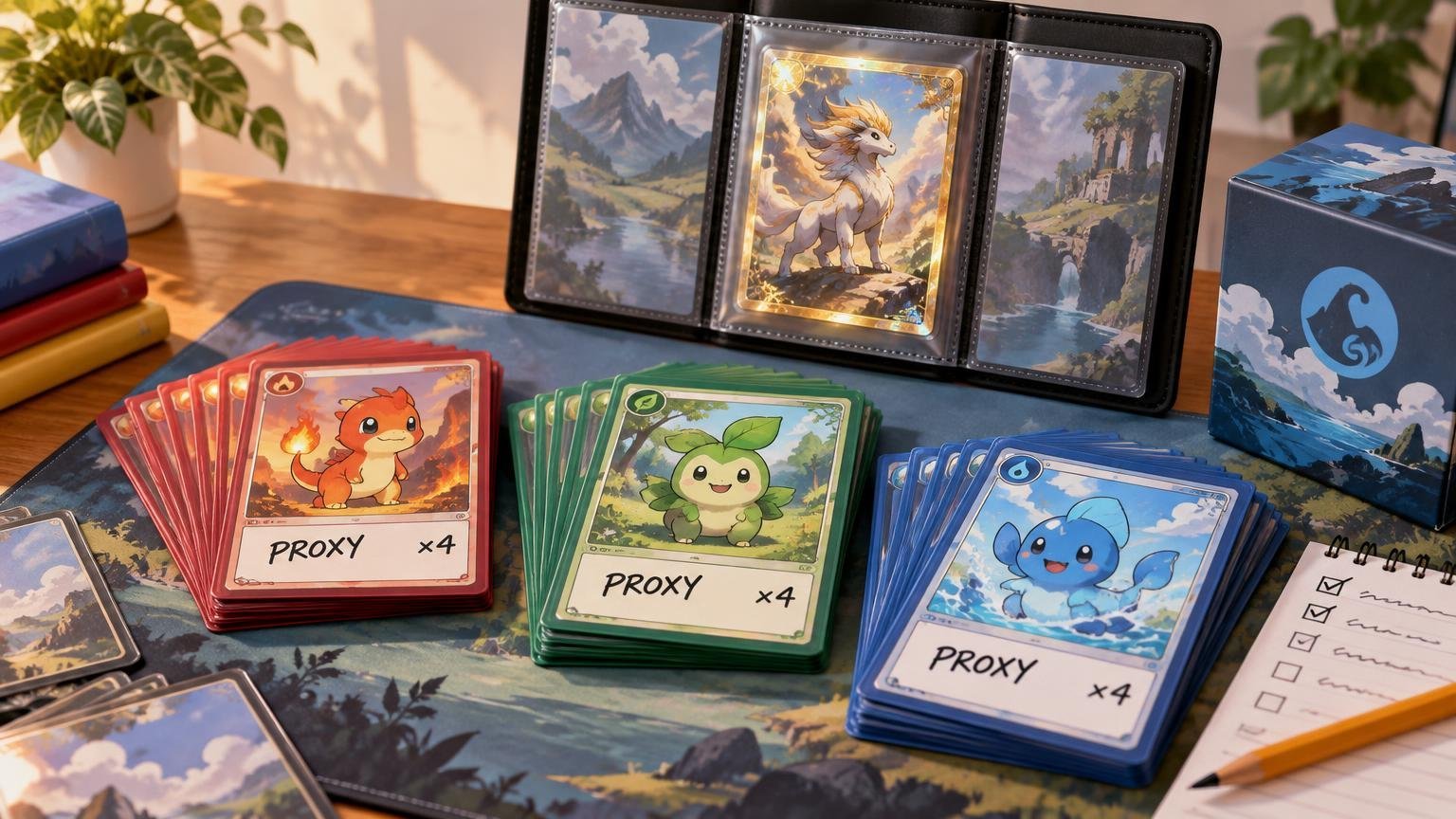
TLDR: For a pokemon proxy shared expensive card multiple decks setup, keep the genuine card in one clearly labeled storage location and put an unmistakably marked test copy in each casual deck that needs it. Tell every opponent what you are using, use matching opaque sleeves, and track how many copies each list is meant to represent. Before sanctioned play, remove all player-made substitutes and rebuild the chosen deck with every required genuine, legal card.
One expensive Pokémon card can support testing across several assembled decks, but the original does not make all of those decks simultaneously tournament-ready. The cleanest system separates ownership from deck assembly: the real card stays protected, while disclosed substitutes preserve the lists you want to test. This extends the testing framework in our guide to deciding which expensive Pokémon cards are worth proxying before purchase.
How to share one expensive Pokémon card between multiple casual decks
Treat the genuine card as part of a small card library rather than as a card that must constantly move between decks. Store it in a labeled binder pocket, toploader, or dedicated deck box, then place a readable substitute in every casual deck where the card belongs. A simple label such as “Proxy,” “Test Copy,” or “Casual Only” should be visible without covering the information needed during play.
This prevents three common problems: forgetting which deck contains the original, damaging a valuable card through repeated handling, and accidentally presenting a test deck as though every card were genuine. It also lets you compare different shells without dismantling one list every time you want to play another.
- Store the genuine card in one consistent, labeled location.
- Write or print the correct card name and gameplay-relevant text on each substitute.
- Mark every substitute clearly as a proxy, test copy, or casual-only card.
- Use the same opaque sleeves throughout each deck so the substitutes cannot be identified from the back.
- Replace any insert, sleeve, or substitute that becomes distinguishable during shuffling.
- Tell your opponent or playgroup about the substitutes before the game begins.
For a list that changes every few games, a paper insert placed in front of an ordinary sleeved card is usually the simplest option. For a stable casual deck that will remain assembled, a prepared full-card substitute may be more convenient. The practical differences are covered in the comparison of paper inserts and full-card proxies for deck testing. Neither approach changes the need for disclosure and permission.
Track where the original is
Create a short inventory note instead of relying on memory. It can live in a notes app, deck-list file, or label inside the storage box. Record the genuine card, its storage location, and every deck containing a test copy.
| Card record | Example entry |
|---|---|
| Genuine copy | Stored in labeled binder pocket |
| Casual Deck A | Two marked test copies |
| Casual Deck B | One marked test copy |
| Casual Deck C | Three marked test copies |
| Event status | Not tournament-ready until rebuilt and verified |
The numbers in this kind of record describe what each list is testing, not how many genuine copies you own. That distinction matters when several decks use different quantities of the same card.
Test the number of copies you would actually play
Owning one genuine card should not limit every test deck to one simulated copy. If a list may need three copies for consistent opening hands or repeated access, test three clearly marked substitutes. Otherwise, you are testing an ownership constraint rather than the deck you might eventually build.
Official Pokémon deckbuilding guidance says a constructed deck contains exactly 60 cards, must include at least one Basic Pokémon, and generally allows no more than four cards with the same name except Basic Energy. The official explanation is available in Pokémon’s introduction to constructing a Pokémon TCG deck. Within those limits, your testing should represent the quantity you are genuinely considering.
For example, play one test set with two copies and another with three. Keep the rest of the list unchanged where possible. Record whether the card appears when needed, becomes redundant in hand, competes with another engine piece, or is frequently discarded. Controlled comparisons are more informative than changing the card count, draw engine, and Energy package at the same time. Our Pokémon proxy deck-testing process explains how to isolate changes between sessions.
What to observe during copy-count testing
- How often the card is available on the turn when its effect matters.
- Whether drawing a second or third copy improves the position or creates a dead card.
- Whether important copies are lost to the Prize cards, discard pile, or an early forced decision.
- How easily the deck can search for or recover the card.
- Which card must be removed when the tested quantity increases.
- Whether the higher count helps difficult matchups or merely improves games the deck already wins.
Do not decide from a single unusually good or bad game. The goal is not to produce a universal sample-size rule; it is to gather enough repeated observations to understand why one quantity works better in that specific deck.
When the shared-card system works
This arrangement is useful for private games, agreed playgroup testing, alternative builds of the same archetype, and experiments with uncertain card counts. It is particularly efficient when a costly staple would otherwise force you to dismantle one working deck whenever you wanted to test another.
Permission still matters. Some casual groups welcome obvious test cards, while stores, Leagues, and independently run events may set different conditions. Ask the organizer before attending rather than assuming that “casual” automatically means proxies are accepted. For a fuller discussion of disclosure and player expectations, see the guide to Pokémon proxy rules and etiquette.
When it does not work
A casual substitute is not an extra genuine copy. It should not be sold, traded, or presented as authentic, and it should not be used where proxies have not been approved. Avoid any substitute that could reasonably confuse another player or collector about what it is.
Player-made testing proxies should also be kept separate from the narrow proxy provisions in official tournament rules. The supplied Play! Pokémon Tournament Rules Handbook allows judge-created proxies only in limited situations involving cards that become unusable or are defective; it does not turn ordinary player-made test copies into legal tournament cards. Because rules and handbook editions can change, consult the current Play! Pokémon rules and formats hub before each sanctioned event.
This means you cannot make several decks tournament-ready by owning one real copy and placing proxies in the others. If two sanctioned decks need to exist at the same time, each needs its own required genuine cards. If only one deck will be played, rebuild that deck completely before registration or deck checks rather than planning a rushed table-side swap.
Before an official event, rebuild and verify the deck
Choose the final deck early enough to inspect every card and sleeve. Remove all substitutes, insert the required genuine copies, and compare the physical deck with your submitted list. Confirm current format legality as well: owning an authentic card does not establish that its printing or card identity is legal in the event’s format.
- Remove every card labeled proxy, test copy, or casual only.
- Add the full number of genuine copies required by the final list.
- Check the current format and card-legality information.
- Verify that the physical deck contains exactly the cards recorded on the deck list.
- Inspect sleeves for marks, wear, transparency, or other differences that could identify cards.
- Count the finished deck and perform a final card-by-card check.
- Ask the organizer or judge about any unresolved legality or card-condition question before play.
Store the unused genuine card carefully after testing rather than leaving it loose beside several deck boxes. Consistent storage reduces unnecessary handling and makes the card easier to locate when you rebuild. The site’s Pokémon card storage guide covers practical protection from bending, scratching, and fading.
A simple system beats constant card swapping
The best shared-card setup is deliberately boring: one protected genuine card, clearly labeled casual substitutes, an inventory note, and honest disclosure before play. It keeps several lists usable while making it difficult to lose the original or confuse a test card with an authentic one.
Use the substitutes to answer a real deckbuilding question, especially how many copies the deck needs and what must be cut to fit them. Once a list is stable, rebuild it with all required genuine cards before any sanctioned event. Players who want a more durable substitute for an established casual list can review the current Pokémon Proxy shop catalog, while checking live availability and product details on the listing itself.