
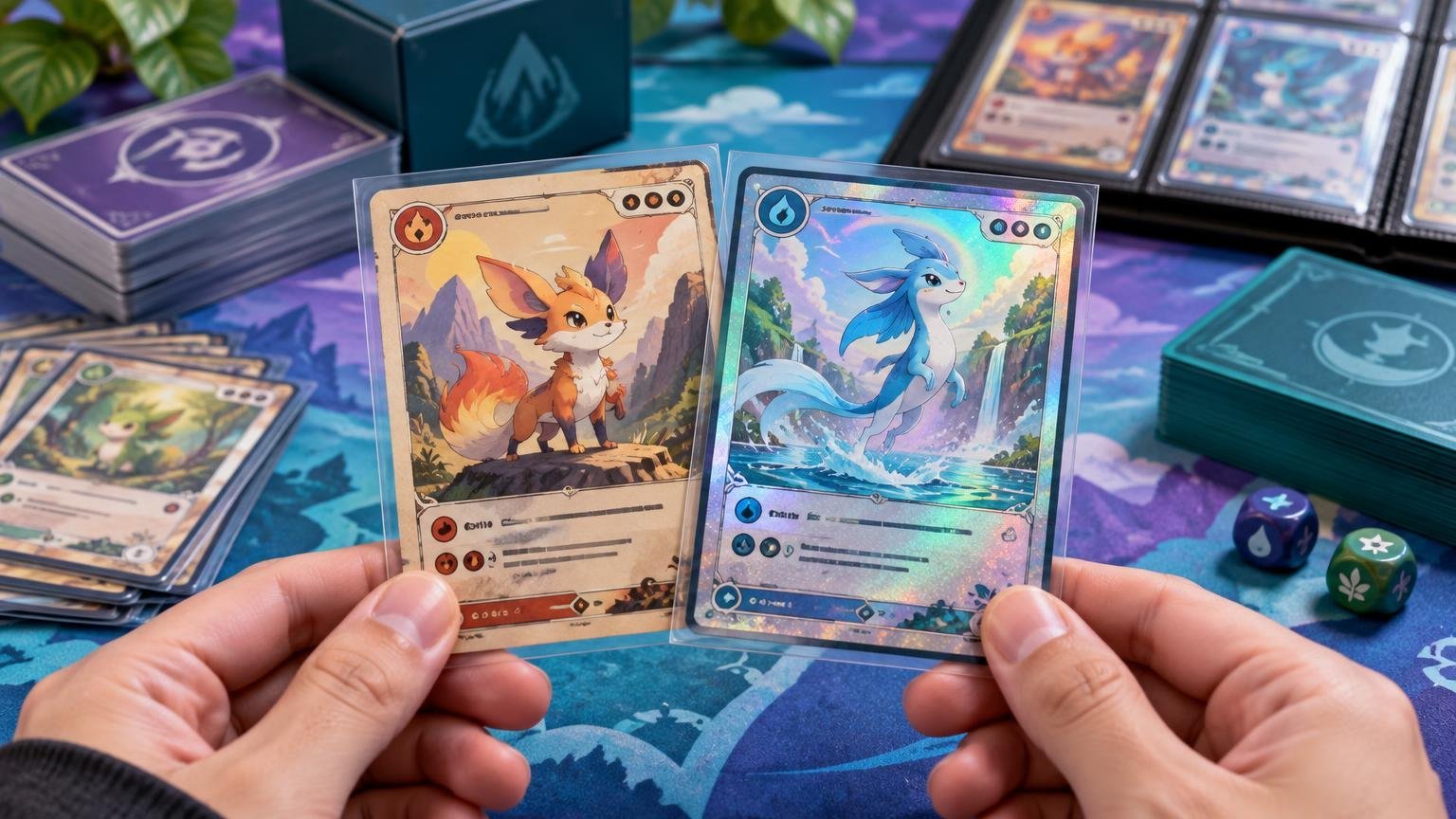
TLDR: Price is not a reliable quality grade for an unofficial Pokémon card. Compare cheap vs premium pokemon proxies by inspecting cut precision, readable text, stock consistency, opacity, finish, holographic execution, packaging information, and the seller’s written defect policy. A simple, inexpensive card can be perfectly suitable for short-term deck testing. Paying more makes the most sense when appearance, repeated handling, batch consistency, or presentation matters.
The terms “cheap” and “premium” sound precise, but there is no standardized proxy-card tier system behind them. One seller may use “premium” for a holographic treatment, another for thicker stock, and another as general marketing language. The useful question is not which label sounds better. It is whether the card’s observable construction fits what you plan to do with it.
Start with disclosure and intended use
A proxy should be represented clearly as an unofficial card rather than sold, traded, or displayed as an authentic Pokémon card. Attractive artwork, a convincing finish, or an accurate size does not change that distinction. Clear disclosure protects buyers and keeps proxies conceptually separate from counterfeits intended to mislead. Learn how Pokémon proxies differ from fake cards before comparing physical quality.
Proxies are most useful for private deck testing, agreed casual games, reusable Cubes, display projects, and gifts whose unofficial status is understood. For sanctioned Play! Pokémon competition, plan to use genuine cards that satisfy the current event requirements. The official Play! Pokémon resources and documents are the appropriate place to check current rules before an event.
What “cheap” and “premium” can actually tell you
Price can reflect stock, finishing steps, low production volume, artwork preparation, seller overhead, packaging, or service. It can also reflect branding without delivering better execution. Conversely, a lower-priced card may be clean and readable because it uses a straightforward design and finish.
Treat the price as one input, not proof. A meaningful comparison asks what you receive for the extra money and whether that improvement matters for your use case. Look for detailed photographs, material descriptions, dimensions language, shipping options, and written remedies for damaged or incorrect orders.
Cut quality is the fastest physical check
Place several cards in a neat stack and inspect the edges. Well-executed cards should have reasonably uniform width and height, consistent corners, smooth edges, and artwork that is not visibly skewed by poor trimming. Slight visual centering differences may not affect play, but inconsistent physical dimensions can make individual cards noticeable in a sleeved deck.
- Check whether opposite borders look balanced rather than sharply tapered.
- Compare corner shapes across several cards from the same order.
- Look for rough fibers, burrs, dents, or peeling along the edges.
- Stack the cards and check for pieces that project beyond the others.
- Sleeve the cards and confirm that none fit unusually tightly or loosely.
For a single display card, a minor dimensional variation may be tolerable if the front looks excellent. In a shuffled deck or Cube, batch consistency matters more because repeated differences can affect handling or make a card identifiable.
Color and text matter more than dramatic saturation
A proxy can look colorful in a product photo while still failing the basic readability test. Zoom in on small rules text, Energy symbols, set information, thin lines, and dark areas. Letters should have defined edges instead of colored halos or blurry shadows. Dense black areas should retain detail rather than swallowing nearby text.
Color accuracy is difficult to judge through a screen because photography, editing, display settings, and lighting all alter the result. Look for consistency across multiple photographs instead of expecting an exact match from one image. For deck testing, readable text and recognizable card identity are usually more important than perfect saturation. Unreadable printing and poor trimming can undermine the usefulness of a test deck even when the cards are sleeved.
Stock, opacity, and shuffle feel are separate qualities
Stock affects stiffness, bend recovery, thickness, opacity, and how cards move against one another. A “black-core” description can be useful because the core contributes to light blocking, but it does not establish the complete quality of a card. It says nothing by itself about trimming, printing, coating, surface durability, or consistency across a batch.
Cards with similar stated weight can still handle differently because core construction, coatings, embossing, fiber composition, and finishing all influence feel. PrintReviewer’s guide to playing-card stock explains how these factors affect opacity and handling.
When evaluating a sample, compare stiffness in both directions, inspect whether the card remains flat, and look for light passing through thin areas. Then sleeve it with the same sleeves and backing cards used throughout the deck. Sleeves reduce many visual and tactile differences, but they cannot fully hide a card that is substantially thicker, thinner, warped, or incorrectly cut.
Finish and holographic execution
A glossy or holographic surface is a treatment, not an automatic quality upgrade. A restrained non-holo proxy may be easier to read under overhead lighting than a more expensive card with strong glare. Check whether the surface looks even, whether it attracts visible scratches, and whether adjacent cards cling together during handling.
For holographic cards, inspect the alignment and coverage of the effect. Ask whether the holo is intended to cover the full face, selected artwork areas, or another region. Look for abrupt seams, cloudy patches, trapped debris, silvering near cut edges, and uneven brightness. Product photos should show the card at more than one angle because a straight-on image reveals little about reflective behavior.
Current PokémonProxy.co listings illustrate why the description must be read card by card: one listing describes a handmade holographic card printed on black-core stock, while another describes an updated card with revised border color and a brighter holographic area. Those statements describe the individual products; they do not establish a catalog-wide production standard or prove comparative superiority.
Consistency matters most in full decks and Cubes
A single beautiful proxy can succeed as a binder piece even if it feels different from an authentic card. A 60-card testing deck has a different requirement: no particular card should be easy to identify from thickness, curvature, finish, or sleeve fit. Official Pokémon deckbuilding guidance confirms that constructed decks contain exactly 60 cards, making batch-level consistency much more consequential than it is for one display card.
The same principle applies to a reusable Cube, where cards may be drafted and shuffled repeatedly. Check a representative sample from different card types and colors rather than examining only the flashiest card. If you are planning a large pool, decide on stock, finish, sleeves, and acceptable tolerances before ordering the whole project. The site’s Pokémon TCG Cube-building guide covers the broader card-pool decisions.
Packaging, delivery, and support belong in the comparison
A well-printed card can still arrive bent or scratched. Before ordering, look for a description or photograph of how cards are protected in transit. Do not infer rigid packaging from the presence of tracking, faster shipping, or a high product price; shipping speed and packaging construction are different issues.
Support also has practical value. Find the seller’s current written terms for defects, transit damage, incorrect items, refunds, replacements, and reporting deadlines. Save the listing description and photograph the unopened package if it arrives damaged. If no remedy is stated, decide whether you are comfortable accepting that uncertainty before paying a premium.
Which quality level fits your project?
| Use case | Prioritize | When paying more may help |
|---|---|---|
| Rapid deck testing | Readable text, correct card identity, uniform sleeved feel | Only when the list is stable enough for repeated use |
| Repeated casual play | Consistent cut, thickness, flatness, and durable finish | When improved consistency or surface durability is documented |
| Binder display | Artwork clarity, color, clean edges, controlled glare | When finish and holo execution are central to the piece |
| Gift | Presentation, disclosure, protective delivery, reliable support | When packaging and a polished finish are clearly included |
| Cube project | Batch consistency, legibility, sleeve fit, repeatability | When the seller can maintain the same construction across a larger order |
For an unstable test list, inexpensive paper inserts or basic full-card proxies often make more sense than polished holographic cards. Compare those approaches in paper inserts versus full-card Pokémon proxies. If a card or playset is expensive enough to delay a genuine purchase, use proxies to answer gameplay questions first; this framework for choosing expensive cards to test can help prioritize the list.
Online-order checklist
- Is the card explicitly described as unofficial or as a proxy?
- Do photos show the front, back, corners, and reflective surface from useful angles?
- Can you read small text and distinguish fine symbols in close-up images?
- Does the listing identify the stock or material without implying that one feature proves total quality?
- Is the finish described as matte, gloss, textured, non-holo, or holographic?
- For a holo card, does the seller explain which areas receive the effect?
- Are size claims clear enough to assess sleeve compatibility?
- Are shipping speed, tracking, and packaging protection described separately?
- Can you find current written terms for defects, damage, incorrect items, and replacements?
- For a batch, can the seller explain whether stock and finish will remain consistent?
Common questions
Is black-core stock enough to identify a premium proxy?
No. Core construction influences opacity and feel, but overall execution also depends on printing, coating, trimming, flatness, and consistency. Treat black core as one useful specification rather than a complete quality grade.
Which flaws matter least in a sleeved test deck?
Small front-side color differences and modest finish differences may become less noticeable in opaque sleeves. Incorrect dimensions, variable thickness, curling, rough edges, and unreadable text remain important because sleeves cannot reliably correct them.
Does holographic mean higher quality?
Not by itself. Holographic treatment adds a visual effect, but its value depends on alignment, evenness, durability, glare, and whether you wanted that appearance. A clean non-holo card can be the better gameplay tool.
Can a local store allow proxies?
A store or organizer may set expectations for an unsanctioned casual activity, so ask before arriving and disclose every proxy. Do not assume that casual permission applies to a sanctioned Play! Pokémon event; check the current official event documents and use legal genuine cards where required.
Judge the card, not the label
The best choice in cheap vs premium pokemon proxies depends on what needs to survive scrutiny. For quick testing, prioritize legibility, uniform sleeve behavior, and low replacement cost. For regular casual play or a Cube, move consistency and durability higher. For display pieces and gifts, scrutinize color, finish, holo placement, edge quality, packaging, and support.
Start with a small sample whenever possible. Compare it under ordinary room light, sleeve it with the rest of your cards, shuffle it, and inspect the edges after handling. Observable execution and honest disclosure tell you far more than a “premium” label ever will.
References
- Pokemon proxy cards: what they are, rules, and etiquette – pokemonproxy.co
- Pokémon Proxy vs Fake Card: The Difference Collectors Need to Know – pokemonproxy.co
- Play! Pokémon Resources and Documents
- Pokemon Proxy Deck Testing: How To Tune Better Lists Before You Buy – pokemonproxy.co
- What Type of Paper Are Playing Cards Printed On? – The Print Reviewer
- Lillie SM – Ultra Prism Holographic Custom Made Pokemon Proxy Card – pokemonproxy.co
- Dark Blastoise Team Rocket (Holo) – Custom Made Pokémon Card – pokemonproxy.co
- An Introduction to Deckbuilding: Learn How to Build a Pokémon TCG Deck