
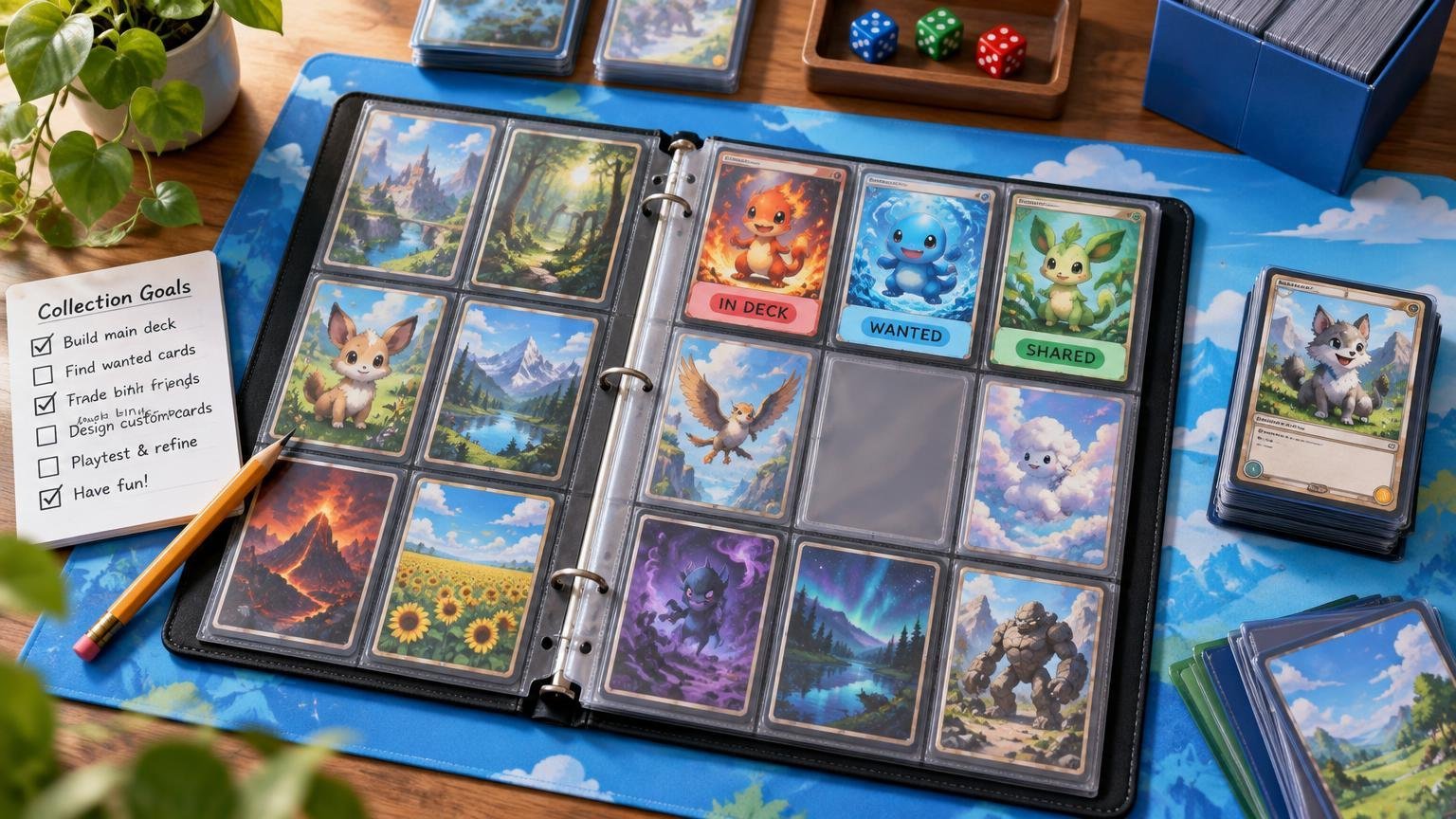
A Pokémon proxy binder placeholder is a stand-in that shows where a card belongs without pretending the unofficial card is part of your authentic collection. It can reserve a slot for an original currently sitting in an active deck, mark a card you still need to purchase, or show that one expensive original is shared between several decklists.
The best placeholders are deliberately obvious. Put the card’s identity and collection status on the front, use a consistent color or symbol system, and never rely on memory to distinguish “owned but in a deck” from “not yet owned.” A binder should tell you what your collection contains, where important cards have gone, and what remains on your want list.
TLDR: Give every placeholder a clear status
- Use “OWNED — IN DECK” when the authentic card belongs to you but is stored in a playable deck.
- Use “WANTED — NOT OWNED” when the slot represents a planned purchase.
- Use “SHARED ORIGINAL” when one authentic card supports several casual decklists.
- Add the deck name or storage location whenever you own the original.
- Make every proxy visibly unofficial, even when its artwork resembles the authentic card.
- Keep binder placeholders out of tournament decks; player-created proxies are not permitted in Play! Pokémon events.
This is a collection-management system, not an official Pokémon TCG rule. The official Pokémon Trading Card Game rules explain gameplay and deck construction, while private binder layouts remain a hobby decision.
Why use placeholders instead of moving cards constantly?
A collection binder and an active deck do different jobs. The binder lets you browse a set, archetype, rarity group, or personal collection. The deck keeps playable cards together and ready to shuffle. Forcing one authentic card to serve both storage roles means either leaving an unexplained hole in the binder or repeatedly moving the card between locations.
A placeholder solves that small but irritating problem. Open the binder and you can still see that the slot is intentional. More importantly, the label tells you whether the missing original is owned, borrowed, shared, or still needed.
That approach follows a broader storage principle: cards can be separated by purpose into binder cards, deck cards, display cards, and trade cards rather than making one copy handle every role. Cards that matter should be sleeved, binder pockets should not be overfilled, and binders are better stored upright than trapped beneath flat stacks.
If you are reorganizing more than a few pages, treat the binder as an inventory rather than a picture book. A visible placeholder preserves the page layout while recording where the real object is. It is especially useful for complete Evolution lines, deck cores, master-set pages, and archetype collections where an empty pocket can otherwise look like an accidental omission.
Three placeholder labels that cover most collections
1. Owned — currently in deck
Use this status only when you possess the authentic card. Add the name of the deck holding it, such as “OWNED — IN GARDEVOIR DECK.” If you maintain deck boxes in several places, add a short location such as “blue box” or “league bag.” That turns the placeholder into a useful retrieval note.
This label is ideal for a favorite full-art card you enjoy seeing in your binder but regularly play. The proxy preserves the visual position while the real card stays safely sleeved with the deck. It also stops you from searching through storage boxes for a card that is already exactly where it should be.
2. Wanted — not owned
A wanted placeholder represents a plan, not inventory. Say so directly. “WANTED,” “NEED 2,” or “NOT YET OWNED” prevents the binder from exaggerating what you have.
This distinction matters when a realistic proxy occupies the same page as authentic cards. Guidance on Pokémon proxy rules and etiquette recommends making unofficial cards obvious, including marking “Proxy” on the front when needed, and never selling or representing them as genuine. A wanted placeholder should therefore communicate both facts at a glance: it is unofficial, and the authentic card has not been acquired.
Wanted placeholders can also make purchasing more disciplined. Instead of maintaining a separate wish list that drifts out of date, update the binder slot when your plan changes. If testing shows that the card does not earn its place, remove the placeholder. If you buy the original, replace the placeholder and record the change in any decklists that also use it.
3. Shared original
One expensive original may support several casual decks even though it can physically live in only one of them. A “SHARED ORIGINAL” placeholder makes that constraint visible. Include the original’s home location and, if useful, the number of authentic copies you own.
For example, a label might read “SHARED ORIGINAL — 1 OWNED — STORED IN DECK A.” Put matching placeholders in the binder or other casual deck boxes that reference the same card. Before playing, move the authentic card to the chosen deck or use an agreed casual proxy if your group permits it.
What to put on a binder placeholder
A useful placeholder needs less artwork than information. A plain insert can work as well as a polished full-card proxy because it will not be shuffled or handled as a playable card. Prioritize legibility over imitation.
| Field | What it tells you | Example |
|---|---|---|
| Card identity | Which authentic card belongs in the slot | Card name and set or printing |
| Proxy marking | That the item is unofficial | PROXY — BINDER PLACEHOLDER |
| Ownership status | Whether you possess the original | OWNED, WANTED, or SHARED |
| Quantity | How many originals or additional copies matter | 1 owned; need 2 more |
| Location | Where the authentic card is stored | Deck A, blue box |
| Date | When the note was last checked | Updated October 2026 |
The card name is usually enough to identify a deck staple, but collectors may also want the set, card number, rarity, or artwork variant. Be specific when two printings occupy different planned slots. “Professor’s Research” alone may not tell you which artwork the page was designed to hold.
A date is optional, but it helps when you frequently rebuild decks. An old “in deck” label can survive long after the deck has been dismantled. Dating the placeholder gives you a quick way to identify notes that deserve checking.
Build a visual system you can understand instantly
Labels carry the meaning, while colors and symbols make the binder faster to scan. You might assign blue to owned cards stored elsewhere, yellow to wanted cards, and purple to shared originals. Another option is a simple symbol in the same corner of every placeholder.
Color should reinforce the written status rather than replace it. A future owner, trading partner, family member, or even you six months later may not remember that a yellow border means “unowned.” Write the status in plain language and use the color as a shortcut.
Keep the format consistent across the entire binder. If “P” means proxy on one page but pending purchase on another, the system creates the confusion it was meant to remove. A small legend inside the front cover can define your colors, abbreviations, and symbols.
Choose the simplest physical placeholder that works
For a static binder slot, you can use a handwritten insert, a printed card image with an obvious overlay, or a full-card custom proxy. The best choice depends on whether you want a functional inventory marker or a visually complete page.
- Plain paper or cardstock insert: fastest to revise and easiest to mark clearly.
- Printed image insert: useful when the artwork helps you recognize the missing printing.
- Full-card proxy: gives the page a more consistent appearance but still needs a visible proxy and status label.
- Reusable status slip: useful when authentic cards move between decks often.
A static binder placeholder does not need to imitate the handling of a playable card. Cut, stiffness, edge feel, and sleeve fit become more important when proxies will be shuffled in a casual deck, where physical differences could make a card identifiable. If you later move a binder proxy into a test deck, review the separate requirements for clearly marked casual-play proxies and uniform sleeved handling.
Avoid stuffing multiple thick cards into one pocket merely to keep the proxy and original together. Overfilled pockets can put unnecessary pressure on cards and pages. Replace the placeholder with the authentic card when it returns to the binder, then store the placeholder in a separate labeled envelope or section for future use.
Turn the binder into a lightweight deck inventory
A placeholder system becomes much more useful when it connects the binder to your deck boxes. Give each active deck a short, stable name. Then use that exact name on binder placeholders instead of vague notes such as “in a deck somewhere.”
When you build or dismantle a deck, run a quick update routine:
- Remove each authentic card from its binder slot.
- Insert an “owned — in deck” placeholder carrying the deck name.
- Record any shared originals that must be moved before play.
- Mark unpurchased test cards as “wanted,” not “owned.”
- When the deck is retired, return authentic cards to their binder slots and remove or revise the placeholders.
If you are still deciding whether a costly card belongs in the list, test that specific slot before turning the placeholder into a purchase. Selective proxying is well suited to an otherwise stable deck when you are evaluating one attacker, engine package, tech card, or prospective playset. A full 60-card test deck is more useful when the strategy itself is unsettled. The guides to tuning Pokémon decks with proxies and deciding which expensive cards to test before buying can help with that stage.
Keep binder placeholders separate from tournament legality
A binder placeholder can organize your collection, but it does not make an unofficial card legal for sanctioned play. The Play! Pokémon Tournament Rules Handbook states that player-created proxies are not permitted. A judge may create a proxy when damage during a tournament produces a marked-card problem, with the damaged original retained as a reference; that narrow procedure does not authorize personal test cards or binder stand-ins.
Constructed Pokémon TCG decks contain exactly 60 cards and generally allow no more than four cards with the same English name, apart from Basic Energy. Before taking a deck to an event, count the actual cards in the deck and remove every personal proxy. Do not assume a binder note proves that the necessary original has been transferred.
For casual play, discuss proxy use with the other players and keep unofficial cards easy to identify outside their opaque sleeves. For sanctioned events, use authentic legal cards and follow the current tournament documents.
Common mistakes that make placeholders misleading
- Using realistic card art without a visible “proxy” or “placeholder” marking.
- Treating a wanted card as though it were already part of the authentic collection.
- Writing “owned” without recording which deck or box contains the original.
- Using one shared original to imply that several complete physical decks are ready simultaneously.
- Leaving old placeholders in place after dismantling a deck or selling a card.
- Moving a binder placeholder into a tournament deck.
- Using unexplained colors or abbreviations that only make sense from memory.
The fix is simple: make status more prominent than artwork. A beautiful proxy can complete the look of a page, but the binder remains useful only when its labels reflect reality. Unofficial display stand-ins and casual-testing tools should remain conceptually separate from authentic collection cards.
A binder should answer three questions
When you open the binder, every occupied or reserved slot should help answer three questions: Do I own this card? Where is the authentic copy now? What action, if any, comes next?
“OWNED — IN DECK,” “WANTED — NOT OWNED,” and “SHARED ORIGINAL” cover most situations without turning card storage into a database project. Add a deck name, quantity, and update date where they provide useful context. Keep the proxy marking impossible to miss.
Done well, Pokémon proxy binder placeholders preserve the shape of a collection while making its gaps honest. The binder stays enjoyable to browse, active decks stay assembled, and expensive originals stop vanishing into a fog of half-remembered deck boxes.
References
- Pokémon Trading Card Game Rules
- Play! Pokémon
- How To Store Pokemon Cards Without Bending, Scratching, Or Fading Them – pokemonproxy.co
- Pokemon proxy cards: what they are, rules, and etiquette – pokemonproxy.co
- Keep Pokémon Proxy Card Cutting Consistent at Home
- A Few Pokémon Proxies vs a Full Deck
- Play! Pokémon Resources and Documents
- Paper Inserts vs Full Card Proxies for Pokémon Deck Testing – pokemonproxy.co