
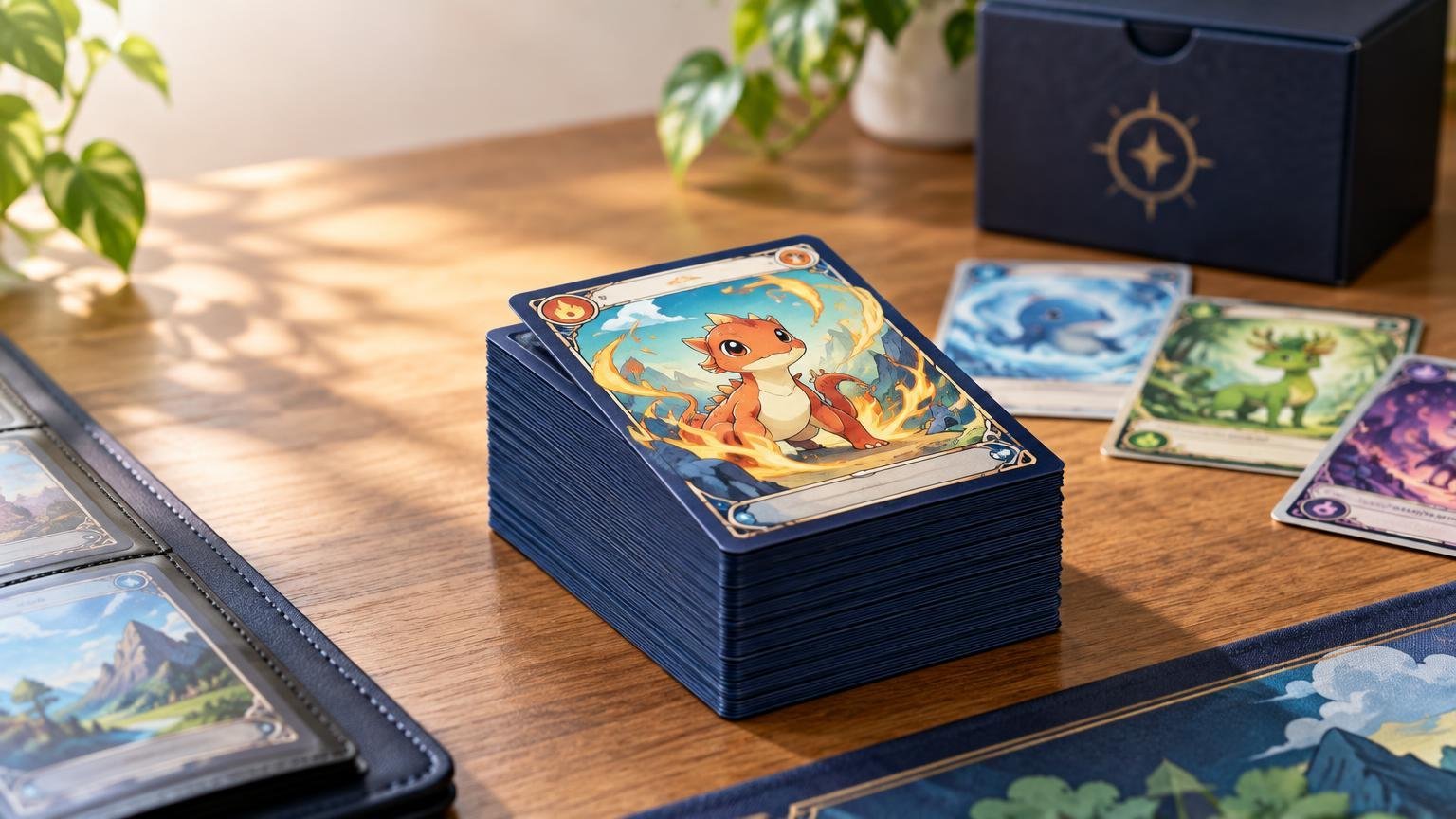
TLDR: For agreed casual play, matching opaque sleeves can make small construction differences less distracting, especially when every paper proxy uses the same kind of backing card. However, sleeves do not guarantee that cards are indistinguishable. Uneven cuts, doubled inserts, damaged sleeves, unusual stiffness, and inconsistent backing cards can still affect shuffling or make one card identifiable.
The practical question behind pokemon proxy card thickness sleeves is not whether a proxy has one perfect measurement. No supplied official source establishes a universal Pokémon card thickness or an approved proxy stock. The better question is whether every card in your casual test deck handles consistently enough that you cannot intentionally locate a particular card.
For a rapidly changing test list, a thin printed face placed in front of a consistent backing card is usually the simplest setup. Use the same sleeve model throughout the deck, disclose the proxies to everyone playing, and reserve genuine cards for sanctioned competition. If you are deciding between temporary inserts and reusable printed cards, compare the workflows in paper inserts versus full-card Pokémon proxies.
When Pokémon proxy card thickness matters less in sleeves
A sleeve creates a common outer surface around each card. That can reduce the visual and handling impact of minor differences beneath it, but only when the rest of the setup is controlled. A loose paper insert by itself will usually bend and move differently from a complete card. Placing that insert in front of an ordinary backing card gives it a firmer structure and makes the deck easier to handle consistently.
PokemonProxy’s proxy-etiquette guidance also recommends backing printed faces with real cards for more consistent casual handling, while keeping casual proxies distinct from cards permitted at official events. The backing card does not need to be valuable. What matters is using the same general backing method for every proxy rather than mixing bare paper, doubled paper, spare cards, and full-card prints in one deck.
- Use one sleeve brand, model, color, and condition across the entire deck.
- Choose sleeves with opaque backs so the underlying card back cannot be seen.
- Trim every insert cleanly so paper does not protrude or bunch inside the sleeve.
- Use one insert per proxy; avoid folded paper or overlapping replacement faces.
- Put the same type of backing card behind each temporary insert.
- Replace split, bent, cloudy, or heavily scuffed sleeves before they become identifying features.
This approach is especially useful when testing and tuning a Pokémon deck before buying cards. You can change counts between games without treating every draft of the list as a permanent printing project.
Where consistency still affects play
Shuffle feel and stack handling
Identical sleeves cannot correct every difference underneath them. A card containing folded paper may be stiffer than the rest of the deck. An insert cut too wide can make a sleeve bow. A thick cluster of inconsistently constructed proxies can also change the deck’s stack height, make piles lean, or cause cards to catch during shuffling.
Test the completed deck rather than judging one card in isolation. Shuffle, draw opening hands, cut the deck, and deal several prize-card layouts. If particular cards repeatedly catch, spring out, or remain easy to locate by touch, rebuild those proxies using the same method as the rest.
Marked-card concerns
Opacity solves only the visual part of the problem. Pokémon’s official League-preparation guidance says sleeves should be identical and sufficiently opaque that card backs cannot be seen under bright light. It also warns that damaged sleeves can create marked-card concerns. Read Pokémon’s official sleeve guidance for the current preparation advice.
A card can still stand out because of a rough edge, crease, air pocket, bent corner, raised insert, different stiffness, or uniquely worn sleeve. For fair casual testing, ask a simple question: could a player reliably recognize this card without seeing its face? If the answer might be yes, replace the insert, backing card, or sleeve.
Durability
Thin paper faces are convenient because they are inexpensive and easy to revise. They are also more vulnerable to wrinkling, moisture, and torn corners during repeated changes. A stable deck used every week may justify full-card proxies or more durable printed pieces, while a list changing after every session benefits from replaceable inserts.
Do not assume that a thicker card is automatically more durable or better. Cut quality, surface wear, bending, print protection, and how tightly the card fits its sleeve all affect practical longevity. A thick but poorly cut piece may handle worse than a simple paper insert with a flat backing card.
Deck boxes and binders
Small differences accumulate across a large deck or Cube. Extra layers can make a deck fit tightly in a box, put pressure on sleeve seams, or cause binder pockets to bulge. Never force an overfilled deck box shut. If the cards bow or the dividers press into the deck, move to a roomier box or simplify the proxy construction.
For cards being stored rather than shuffled, prioritize flatness, clear identification, and avoiding pressure. The site’s guide to storing Pokémon cards without bending or scratching them covers the broader storage risks. Clearly label unofficial custom or proxy cards so they cannot later be mistaken for authentic collection pieces.
Choose the setup for the job
| Use case | Practical construction | What to prioritize |
|---|---|---|
| Fast at-home testing | Printed paper face, consistent backing card, matching opaque sleeve | Fast edits and readable card text |
| Repeated casual testing | Uniform inserts or consistently made full-card proxies in matching sleeves | Shuffle consistency and durability |
| Pokémon Cube | One construction method across the reusable card pool | Consistent drafting, handling, and replacement |
| Binder or display project | Flat, clearly identified unofficial card in suitable protection | Appearance, labeling, and avoiding pressure |
| Play! Pokémon event | Genuine cards unless event staff apply a permitted exception | Current official rules and judge direction |
A Cube deserves stricter consistency than a one-evening test deck because its cards are drafted, shuffled, and reused across many sessions. Use the same sleeve system and construction method throughout the pool rather than improving only the rare or expensive selections. The Pokémon TCG Cube building guide explains how proxies can support a casual Cube while keeping organized-play legality separate.
If you prefer finished custom cards over changing paper inserts, review the current PokemonProxy shop catalog without assuming that every listing uses the same material or construction. Product availability and specifications can vary, so check the individual listing that interests you. A seller’s claim that a card uses normal Pokémon-card dimensions also does not establish that its stock or thickness matches a genuine card.
A five-minute consistency check
Before playing, inspect the whole deck as a physical object. This quick check catches more practical problems than chasing an unsupported target thickness.
- Place the sleeved deck on a flat surface and look for leaning, bowing, or cards that rise above the stack.
- Turn the deck face down under bright light and confirm that no card back, backing-card color, or insert outline is visible.
- Run a finger gently along all four edges and rebuild any card with a protruding or unusually rough insert.
- Shuffle and cut several times, noticing whether the same cards catch or separate from the stack.
- Replace visibly damaged sleeves with matching spares, then ask the other player whether the deck feels acceptably consistent.
This is not a certification that the proxies are impossible to detect. It is a practical fairness check for disclosed, unsanctioned testing. If your group has stricter expectations, agree on the construction method before building the deck.
Casual permission is not tournament legality
Player-made proxies and judge-issued tournament proxies are different things. For kitchen-table games, testing sessions, or a private Cube, the organizer and players decide whether unofficial cards are acceptable. Ask first, disclose what you are using, and make the cards easy to distinguish from authentic collectibles outside their sleeves. The broader Pokémon proxy rules and etiquette guide provides a useful starting point.
For Play! Pokémon competition, do not assume that good sleeves or accurate dimensions make a player-made proxy legal. Consult the current Play! Pokémon rules and resources before attending. The supplied October 2023 Tournament Rules Handbook required genuine Pokémon TCG cards and described only a narrow process in which tournament staff could create a temporary proxy for a card damaged and marked during an event. That older staff-issued exception is not permission to bring a homemade substitute, and current event documents and judge instructions control.
The useful rule: match the deck, not an invented number
Sleeves often make modest construction differences less distracting in casual Pokémon testing, but they do not erase every tactile clue. A fair setup comes from repeatability: one backing method, one sleeve type, clean inserts, undamaged edges, and open disclosure.
Start with paper faces, inexpensive backing cards, and matching opaque sleeves if the list is still changing. Upgrade to more durable, consistently constructed pieces when the deck or Cube becomes stable. If one card can be found by touch, catches during every shuffle, or makes the stack visibly uneven, rebuild it before the next game.