
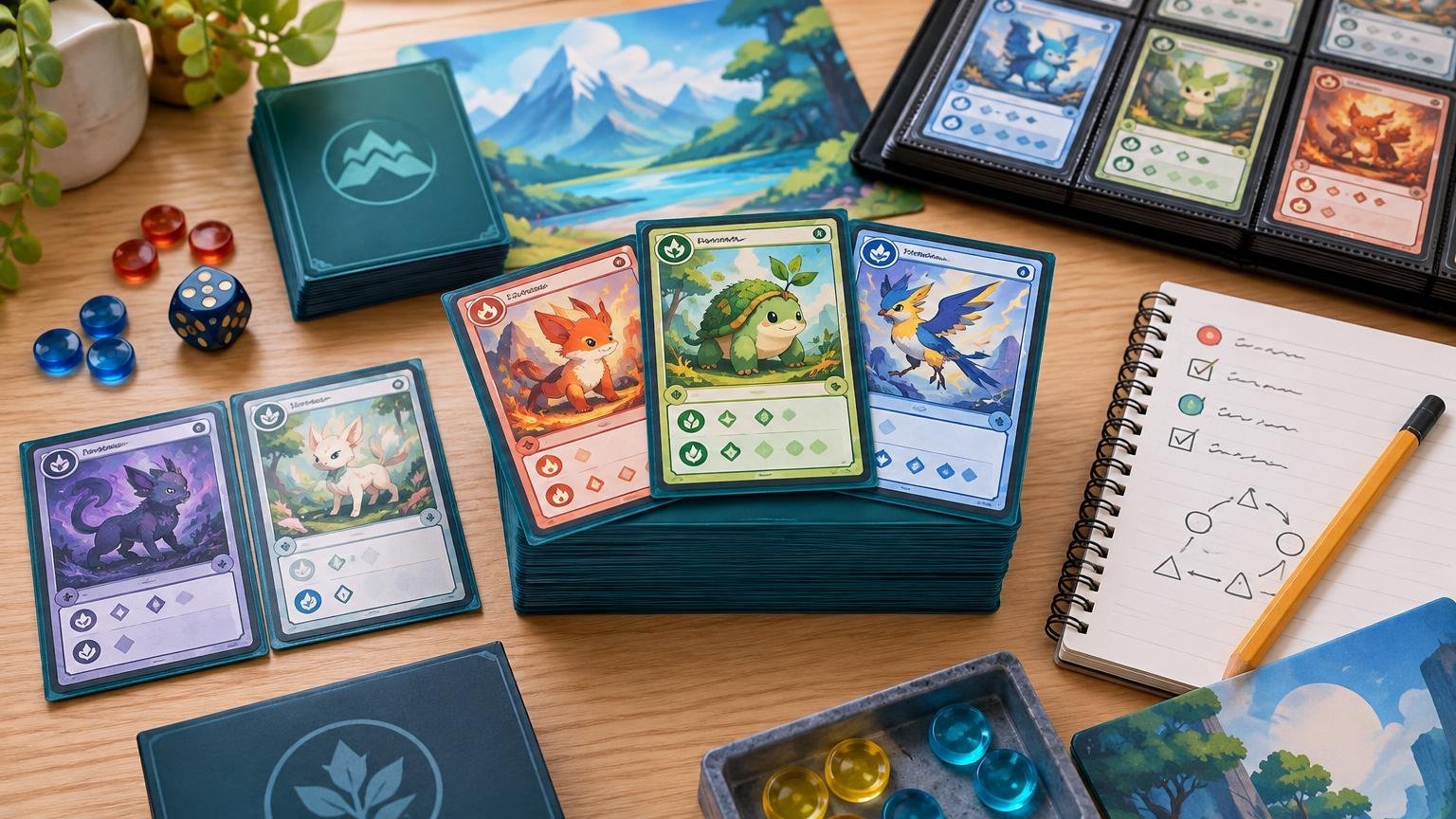
TLDR: Build a realistic 60-card version of the archetype with proxies, then test four things separately: setup consistency, recovery after disruption, enjoyment over repeated games, and the copy counts you would actually buy. A pokemon proxy test new archetype session should help you make a purchase decision, not supposedly prove that the deck is tournament-ready.
The expensive mistake is not buying one disappointing card. It is buying an attacker, its support engine, several specialized Trainers, and a playset of staples before discovering that you dislike the deck’s core loop. A pokemon proxy test new archetype workflow lets you experience the complete play pattern first, including its awkward hands and failed setups rather than only its ideal turns.
What a new-archetype proxy test should answer
A useful test is more focused than playing a few casual games and asking whether the deck won. Winning can hide clumsy setup, while losing can come from an unfavorable matchup or ordinary variance. Judge the archetype through four separate questions:
- Consistency: Does the deck find its intended opener, engine pieces, Energy, and main attacker often enough to function?
- Resilience: Can it rebuild after an important Pokémon is Knocked Out, a resource is discarded, a key card is Prized, or the opponent disrupts the hand?
- Enjoyment: Do you like making the deck’s recurring decisions, or does the central loop already feel repetitive or frustrating?
- Purchase value: Which cards repeatedly matter, and which expensive inclusions are merely conventional, situational, or unnecessary at their current counts?
Keep these questions distinct. A powerful archetype may still be a poor purchase if you dislike piloting it. An enjoyable deck may be worth building for casual play even if its results against a particular competitive matchup are modest.
Build a rules-shaped 60-card test deck
Do not begin with a loose pile of the archetype’s most exciting cards. Pokémon’s official deckbuilding guidance says a normal deck contains exactly 60 cards, includes at least one Basic Pokémon, and generally allows no more than four cards with the same name other than Basic Energy. The official Pokémon deckbuilding introduction explains this foundation. A realistic test list should follow those constraints so that setup pressure and opportunity costs remain visible.
Proxy the complete package you intend to play: the main attacker, supporting Pokémon, draw and search engine, switching options, recovery cards, Energy, tech choices, and their proposed copy counts. Using proxies only for the expensive cards while filling the remaining slots with whatever is nearby can distort the test. You need to know whether the whole system works, not whether one premium card looks strong in isolation.
That does not mean every card must receive the same physical treatment. Cheap paper inserts are practical while the list is changing every session. More durable full-card proxies become useful after the list stabilizes and will be shuffled repeatedly. The paper inserts versus full-card proxies comparison can help you choose without overbuilding an early draft. Use opaque, matching sleeves and make every unofficial card readily identifiable outside the sleeve.
How to run a pokemon proxy test new archetype session
1. Goldfish opening hands
Start without an opponent. Draw an opening hand, set up as normal, and play the first few turns toward a clearly defined target. That target might be establishing the engine, preparing the main attacker, or reaching the deck’s expected first meaningful attack.
Reset and repeat with fresh hands. Do not rescue awkward starts by informally searching for the missing card. The failed hands are valuable evidence. Record whether the opening hand was playable, which piece was missing, and whether the deck had a realistic route to recover.
Goldfishing is especially good at exposing structural problems: too few Basics, too many situational cards, Energy that cannot be accessed at the right time, or an engine that consumes more deck space than expected. It does not tell you how the deck handles pressure, so it is only the first layer.
2. Play repeated games into one defined matchup
Choose one opposing deck and keep it constant for a testing block. This gives your changes a stable context. If you switch opponents, tech cards, starting assumptions, and several deck slots after every game, you will not know what caused the result.
Track the archetype’s actual jobs rather than only wins and losses. Did it establish its main attacker? Did the engine become active when needed? Were search cards live throughout the game? Did a supposed matchup tech affect a meaningful decision? A loss in which the deck executed its plan can be more informative than a win caused by the opponent drawing poorly.
3. Stress its recovery plan
Pay attention when the clean sequence breaks. Note games where a key Pokémon is Prized, an attacker is Knocked Out earlier than expected, an Energy attachment is missed, or an important resource must be discarded. Then ask whether the list contains a practical recovery line—and whether you recognized it while playing.
This separates a consistent-looking opening from a resilient deck. Some engines produce impressive first turns but leave few options after disruption. Others start more slowly but preserve choices later. Which pattern is preferable depends on the archetype and on what you enjoy piloting.
Use a lightweight test log
A test log does not need damage-by-damage notes. Record only observations that could change the list or buying decision.
| Test point | What to record | Why it matters |
|---|---|---|
| Opening hand | Playable, awkward, or forced mulligan | Reveals whether the list begins functioning reliably |
| Setup target | Reached on time, reached late, or missed | Tests the archetype’s intended early sequence |
| Main attacker | When it became usable | Shows whether the deck converts setup into pressure |
| Engine | Active, delayed, or unavailable | Separates engine performance from attacker performance |
| Important resources | Prized, discarded, stranded, or inaccessible | Exposes recovery and redundancy needs |
| Tech card | Relevant, irrelevant, or never found | Helps justify inclusion and copy count |
| Disruption recovery | Recovered cleanly, slowly, or not at all | Measures resilience after the ideal line fails |
| Enjoyment | Wanted another game, neutral, or ready to stop | Tests whether the repeated play pattern suits you |
Patterns matter more than one dramatic game. Repeatedly drawing a card at the wrong time is a reason to examine its role. One unlucky opening hand is not automatically a reason to rebuild the deck.
Compare engines and copy counts without muddying the result
When testing two engines, hold the rest of the deck as steady as possible. Give each version the same matchup and broadly similar test conditions. Compare setup, available choices, recovery, and deck-space cost—not just the final record.
Change only a small group of cards before repeating the test. Swapping two to four slots is often easier to interpret than rebuilding twenty cards at once. If you change the Pokémon engine, Energy package, search cards, and matchup tech simultaneously, any improvement becomes difficult to attribute.
Use the same approach for a costly staple. Test the count you are genuinely considering, whether that is one copy or a full playset. Then reduce the count and note what changes. If the fourth copy rarely improves access, recovery, or the opening sequence, you have learned something useful before paying for it. The framework for deciding which expensive Pokémon cards deserve proxy testing can help prioritize the uncertain purchases.
Turn the results into a purchase plan
Buy the pieces whose roles survived repeated testing. Start with the archetype-defining cards and engine components that consistently enabled the play pattern you enjoyed. Purchase flexible staples when their tested count was useful across many hands or when they can move into other decks.
Delay cards that were frequently dead, relevant only in one narrow matchup, or included mainly because another list used them. A popular engine is not automatically the right engine for your shell. Likewise, owning four copies is unnecessary if your tested list performs its intended job with fewer.
Before purchasing for Standard play, verify that every card will remain legal for the period in which you plan to use it. Rotation can materially change an engine’s value. For example, the official 2026 rotation announcement schedules regulation mark G to leave in-person Standard play on April 10, 2026, while marks H, I, and J remain legal for that format period, subject to applicable reprint rules. Check current information again at the time of purchase rather than treating an old deck list as evergreen.
If one authentic expensive card will eventually serve several casual decks, you can also use a clear tracking system instead of buying unnecessary duplicates. This guide to sharing one expensive card across multiple proxy decks explains how to preserve accurate copy counts and rebuild a sanctioned-play deck correctly.
Keep casual testing separate from sanctioned play
Player-made proxies are best treated as private or organizer-approved casual testing materials. Ask the other player or local organizer before using them, make them easy to distinguish from authentic cards, and never trade or sell them as genuine cards. The broader Pokémon proxy rules and etiquette guide covers those boundaries.
Do not assume a player-made proxy will be accepted at a Pokémon League event or sanctioned tournament. Rules and resources are updated, so consult the current Competitive Pokémon Rules and Formats page and confirm event-specific questions with the organizer before attending. Build the event deck with eligible authentic cards unless the current rules and tournament staff explicitly provide otherwise.
Make the next decision, not a final verdict
A proxy session cannot prove that a new archetype is competitively viable. It can answer the decision immediately in front of you: Does the deck set up often enough, recover in ways you like, create interesting repeated games, and justify the engine or staple counts you would need to buy?
Start with the full 60-card concept, record the same few signals each game, and revise only a handful of slots at a time. Once the list’s core loop remains useful and enjoyable through both clean and awkward games, you will have a much stronger basis for deciding which authentic cards are worth purchasing.