
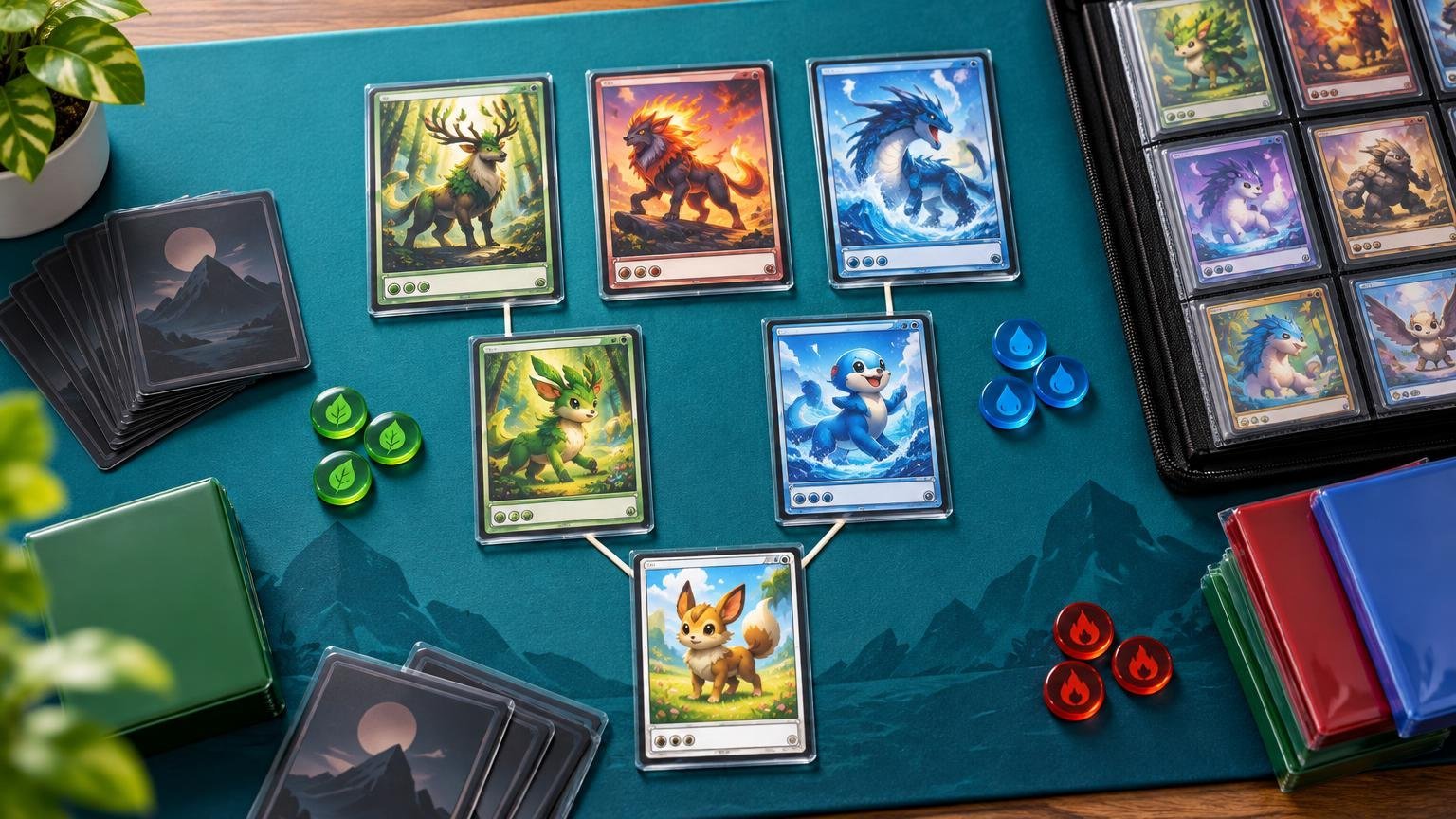
The best Pokémon Cube Evolution lines are not miniature Constructed deck lists. They are overlapping packages designed to survive contested picks, uneven packs and imperfect information. Start with more Basics than Evolutions, give Stage 2 lines extra lower-stage support, and use shared Basics, branching lines and flexible search to make more picks functional.
TLDR: Build for the draft, not the ideal deck
- Count playable copies at every stage, not just the number of Pokémon species.
- Use a Basic-heavy structure. A 3–2–1 Basic/Stage 1/Stage 2 line is a reasonable first prototype, while central archetypes may need 4–3–2 or more support.
- Duplicate important Basics and Stage 1 cards instead of forcing singleton construction.
- Favor branches that share an exactly named Basic or Stage 1.
- Include search that can find the stages your Cube actually asks players to assemble.
- Draft the Cube repeatedly and record stranded Evolutions, missing Basics and lines that assemble too automatically.
Why Evolution lines fail in a Cube
Under normal Pokémon TCG rules, a Stage 1 or Stage 2 card identifies the Pokémon from which it evolves. The required earlier stage must already be in play, and a Pokémon ordinarily cannot evolve on its first turn in play or evolve twice in one turn. Name matching matters: a card that evolves from Geodude cannot simply evolve from Brock’s Geodude. Regional forms, owner names and other variants can create the same trap.
That dependency becomes harsher in a draft. A strong Stage 2 may be useless if another player takes its only Basic, its Stage 1 appears in an unopened pack or the drafter never sees enough search. A Cube therefore needs redundancy rather than merely complete-looking evolutionary families. The broader Pokémon Cube design framework covers archetypes and balance; here, the narrower goal is making those Evolution packages assemble at the table.
Set Basic, Stage 1 and Stage 2 density
There is no universal ratio because Cube size, player count, pack construction and house rules all change access. Still, each higher stage should usually have at least as much access to its prerequisite as to itself. A line with one Basic, one Stage 1 and two exciting Stage 2 cards looks generous at the top but has a single failure point at the bottom.
| Line role | Prototype package | Why it works |
|---|---|---|
| Minor Stage 1 line | 2 Basics, 1–2 Stage 1 cards | Compact, but still gives drafters more than one route to the required Basic. |
| Normal Stage 2 line | 3 Basics, 2 Stage 1 cards, 1 Stage 2 card | A practical first draft for a supported payoff without flooding the Cube. |
| Featured Stage 2 archetype | 4 Basics, 3 Stage 1 cards, 2 Stage 2 cards | Supports competition for the line and makes the archetype more likely to appear. |
| Branching family | 3–4 shared Basics, 3–4 total Stage 1 branches | Turns the Basic into an open-ended pick instead of an early commitment. |
Treat these as starting configurations, not laws. Count functional access too. A Pokémon with a setup Ability, a Trainer that finds the correct category, or intentional pack collation can change how often a line assembles. Conversely, a Basic that belongs to a weak or narrow strategy may need more copies because players will not take it speculatively.
Use shared Basics and branches to reduce dead picks
Branching Evolutions are excellent Cube tools when several Stage 1 cards evolve from the same exact Basic. A drafter can take that Basic early, watch which archetype remains open and choose the relevant branch later. Multiple Stage 2 cards can perform the same trick when they share a named Stage 1. The printed evolution requirement still applies, so visual similarity or belonging to the same character family is not enough.
Shared pieces also create meaningful competition. One branch might support a damage-focused deck while another supplies draw, disruption or a defensive pivot. That is healthier than assigning every Evolution family to one sealed archetype package. The pick remains useful without becoming automatic.
Use the official Pokémon TCG card database instructions to search by stage or pre-evolved form while mapping possible branches. Record the exact “Evolves from” name in your Cube list rather than relying on memory.
Choose search cards by what they actually find
“Pokémon search” is not one interchangeable category. Card text may search for Basic Pokémon, Evolution Pokémon, any Pokémon or a card that evolves from a particular Pokémon. A Cube packed with Basic-only search can still leave its Stage 2 payoffs stranded. Boost Shake is a more specialized example: it finds a card that evolves from one of your Pokémon and puts that card directly into play, but it also ends the turn.
Build a small search matrix for the Cube. Mark whether each Trainer or Ability accesses Basics, Evolution cards, named lines or all Pokémon. Then compare that coverage with the Evolution density. Broad search should act as shared infrastructure, while narrow search can reward a particular archetype without becoming mandatory for every deck.
Decide how much variance the Cube should keep
Ordinary all-stage drafting creates tension, but it also creates misses. If too many decks fail before the games begin, adjust the environment rather than simply adding stronger Pokémon. Options include duplicating lower stages, seeding related cards into the same pack, loosely collating packs by card role or adopting a clearly stated alternative evolution rule. The general guide to building a Pokémon TCG Cube explores these structural choices in more detail.
Pokémon’s official Alternative Play Handbook offers another reference point. Its Ditto Draft format lets eligible Basic Pokémon receive a Ditto Marker and evolve into drafted Stage 1 or Stage 2 cards under format-specific restrictions. This is an official draft workaround, not the normal evolution procedure and not a rule every private Cube should adopt. It is useful inspiration when your group values flexible drafting over strict line assembly. Read the official Alternative Play Handbook.
Test whether the lines are genuinely draftable
A line is draftable when players can recognize it, acquire enough pieces and build a functional deck despite competition. Its isolated power level matters less if its Evolution cards routinely sit in side piles.
- Record every Evolution card that finishes a draft without its prerequisite.
- Track Basics taken by players who never use their branches.
- Note whether the strongest Stage 2 is always an automatic first pick.
- Check whether search cards reach the stages players actually miss.
- Watch for archetypes that work only when one drafter receives every related card.
- Separate gameplay losses from draft failures: a line can be balanced in battle but almost impossible to assemble.
Change one variable at a time. Add a Basic, duplicate a Stage 1, replace narrow search or adjust pack collation, then draft again. If the Cube is still changing rapidly, use inserts or another easy revision method before committing to a complete polished set; the guide to printing a Pokémon Cube in stages explains why that approach suits an evolving list.
Build from the bottom of the line upward
Choose the Basic infrastructure first, identify which branches create real draft choices, and add Stage 2 payoffs only after their lower stages have enough access. The result should not guarantee every drafter a perfect chain. It should make Evolution a manageable drafting challenge rather than a lottery decided by where one indispensable Basic happened to land.