
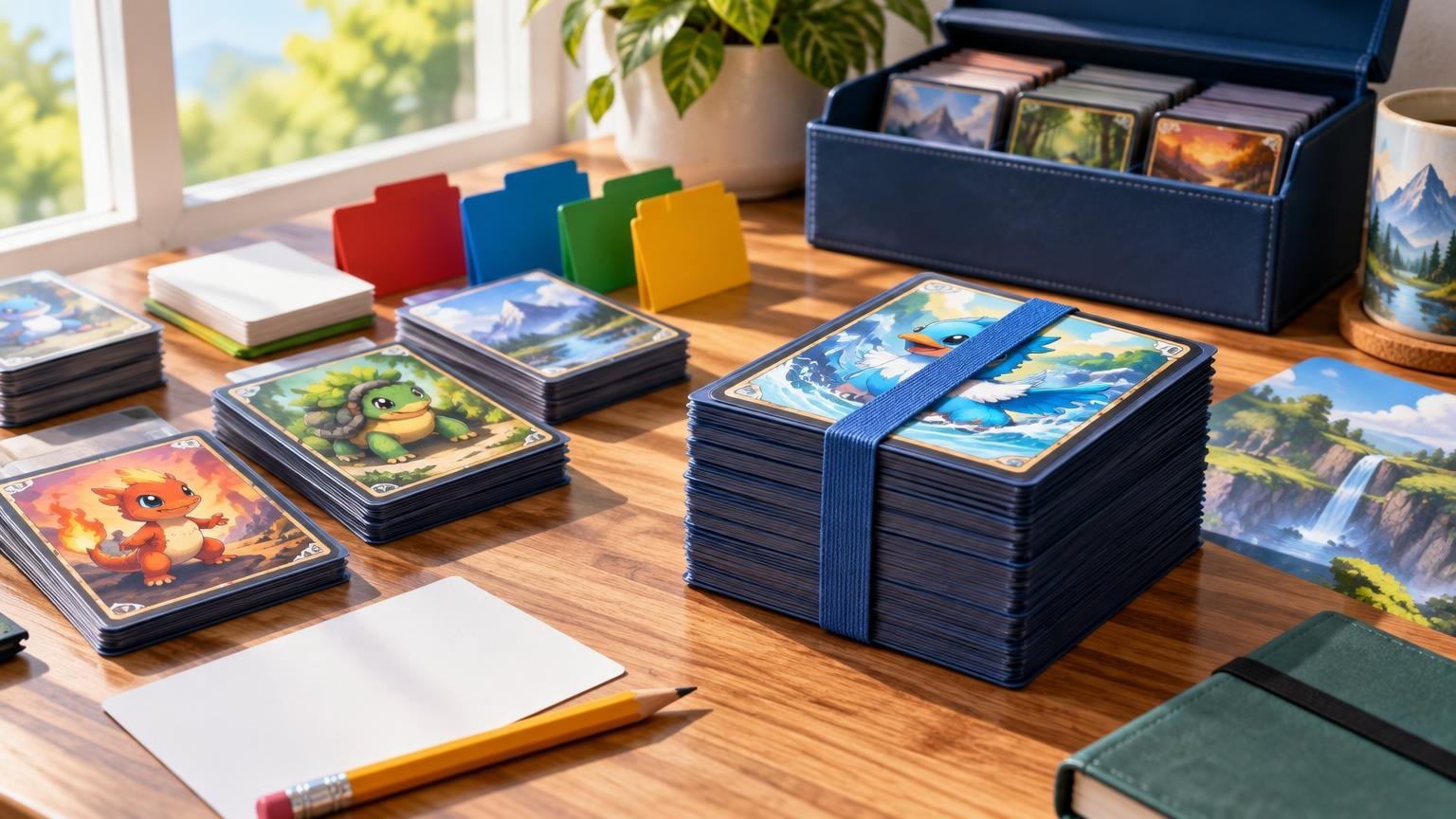
TLDR: If you are asking whether to print pokemon cube all at once, base the decision on list stability rather than card count. Use inexpensive inserts or temporary cards while archetypes, Evolution lines, Energy rules, and draft patterns are changing. Commit to a full run when complete drafts produce functional decks and most updates are isolated substitutions rather than structural rewrites.
Printing everything early gives the Cube a consistent physical form, but it also turns every major revision into wasted cards or a mismatched replacement batch. For most new Cubes, the practical answer is staged production: test the whole environment first, print the proven core later, and maintain a small revision reserve for future changes.
Should You Print Your Pokémon Cube All at Once?
Print the complete Cube when its rules and card pool have survived repeated full-table testing. A theoretical list can look balanced in a spreadsheet while producing stranded Evolutions, unsupported strategies, automatic first picks, or decks that cannot execute their plans. PokémonProxy’s existing Cube guidance therefore emphasizes complete drafts, archetype support, Evolution access, Energy, and measured revisions rather than treating the first list as final.
The decision is not simply temporary cards versus good cards. It is a choice among flexibility, consistency, assembly time, and replacement cost. The right production stage depends on how often the list changes and how much repeated use the Cube receives.
| Production approach | Best fit | Main advantage | Main drawback |
|---|---|---|---|
| Temporary inserts | New or rapidly changing Cubes | Fast, low-commitment revisions | More preparation and less uniform handling |
| Hybrid production | Cubes with a stable core and volatile packages | Durability where it matters while preserving flexibility | Requires tracking which sections are final |
| Complete production | Mature Cubes used repeatedly | Consistent handling and easier recurring setup | Structural revisions can leave many printed cards unused |
Use iterative printing while the Cube is still changing
A Cube is still in its experimental phase when most sessions reveal changes to packages rather than individual cards. If a draft causes you to add an entire archetype, rebuild several Evolution lines, change the Energy system, or alter the deck-building rules, flexibility is more valuable than polished production.
Paper inserts are especially useful here. Put each clearly labeled insert in an opaque sleeve with a consistent backing card, then replace the insert when the list changes. This keeps revisions quick and avoids committing production money to cards that may survive only one session. The detailed comparison of paper inserts and full-card Pokémon proxies reaches the same practical distinction: inserts suit frequent revisions, while complete proxy cards make more sense for stable, repeatedly used lists.
Stay in the iterative phase if you regularly see any of these signs:
- Players draft part of an Evolution line but cannot reasonably find or use the other stages.
- One strategy consistently produces functional decks while another rarely comes together.
- A small group of cards are automatic early picks regardless of the player’s intended archetype.
- Several cards remain undrafted or sit unused in final decks across different sessions.
- Players lack enough broadly useful Trainers, draw effects, search options, or flexible attackers.
- You revise the Cube’s Energy access, deck size, Prize count, or drafting procedure after most events.
Do not wait for perfect balance; a living Cube will always change. The relevant question is whether revisions have become narrow and intentional. Replacing one overperforming attacker is ordinary maintenance. Rebuilding three archetypes because their decks never function is evidence that full production should wait.
Full production makes more sense once the Cube is stable
A mature Cube does not need to produce identical games. It should instead generate varied drafts in which several supported strategies can become functional decks, even when players contest key cards. Evolution lines should be accessible enough for the Cube’s chosen draft method, while Trainers and other generic support should help players recover when a narrow plan does not come together.
Before ordering or making the complete card pool, look for stability at three levels. First, the Cube’s rules should be settled: players understand what they draft, what is supplied separately, and how decks are built. Second, its structural packages should recur successfully across different seats and draft orders. Third, post-session changes should usually involve individual cards or small clusters rather than whole sections.
Physical consistency matters more as usage rises. A Cube drafted frequently, transported to game nights, reset by different people, or loaned to friends benefits more from durable, readable cards with consistent cuts and backs. Matching opaque sleeves also reduce handling differences, although sleeve condition and card construction can still affect how cards feel. See the guide to card thickness and sleeved Pokémon proxies for the practical handling considerations.
A hybrid approach often gives the best balance
Hybrid production means producing the stable core while leaving uncertain packages as inserts or other temporary playtest cards. This is often the most efficient choice for a Cube that plays well but still has one or two experimental sections.
Good candidates for the stable batch include widely used Trainers, proven archetype anchors, long-standing Evolution lines, and cards that have survived several revisions. Keep volatile tech cards, newly added strategies, alternate versions of similar effects, and experimental rule modules temporary. When those sections stop changing, they can join a later replacement batch.
The split should follow design risk, not card rarity or visual importance. An exciting centerpiece can still be unstable if it distorts every draft. A modest search card may deserve permanent production sooner if it consistently helps multiple decks function.
What to Test Before Committing to a Full Print Run
Test complete drafts, not only sample hands or two preassembled decks. Cube balance depends on competition for cards, seat position, signals, and whether players can pivot when their first plan closes. The broader Pokémon Cube balance framework explains how card selection, archetypes, and Evolution lines interact across the environment.
Use a short post-draft record instead of relying on the loudest result. For each session, note:
- Which archetypes were attempted and which became playable decks.
- Which Evolution cards were stranded in draft pools or final builds.
- Which cards were picked immediately and which went around the table repeatedly.
- Whether contested strategies still had fallback attackers and support.
- Whether supplied Energy and deck-building rules created meaningful choices or merely extra friction.
- How long sorting, sleeving, drafting, and resetting took.
- What you would remove, add, or restructure before the next session.
The last question is especially revealing. If your proposed changes fit on a small substitution list, complete production may be reasonable. If the notes describe a new draft system or a rebuilt card pool, keep iterating.
Budget, Convenience, and Maintenance Tradeoffs
A larger budget can justify earlier production as a convenience choice, but it does not make the design finished. Some builders value a consistent-looking pool enough to accept replacement costs. Others would rather spend less during development and do more hand assembly. Neither approach changes the underlying balance work.
Before choosing a production route, verify the provider’s current ordering workflow, accepted files or lists, card specifications, minimum quantity, replacement policy, and delivered price. Do not assume that a service advertising trading-card printing can accept a complete custom Pokémon Cube. A sample or small stable package is a safer first order when compatibility and physical consistency have not been established.
Reserve part of the budget for maintenance. Even a successful Cube may need replacements for damaged cards, readability corrections, or later balance updates. Keeping spare sleeves and a clearly documented master list also makes additions less disruptive.
Choose Cube Rules Before You Finalize the Card Pool
Pokémon Cube is a casual, house-rule format, so normal constructed deck rules are a reference point rather than an automatic requirement. Official Pokémon deckbuilding guidance describes standard constructed decks as exactly 60 cards, with at least one Basic Pokémon and the usual limit of four cards with the same name except Basic Energy. A Cube can deliberately use different rules, but those differences should be fixed before final production because they affect card density and archetype support.
For example, official Prerelease events use 40-card decks, separately supplied Basic Energy, and four-Prize games. Play! Pokémon’s Prerelease Event Guidelines can therefore provide a useful starting model for a compact Cube, although a Cube is not required to copy that structure.
Supplying Basic Energy outside the draft often keeps packs focused on meaningful choices. Drafting Energy can still work when Energy access is itself part of the intended challenge. Decide which experience you want before printing Energy as part of the main pool; changing that choice later can alter a substantial portion of the list.
Keep Casual Cube Play Distinct From Organized Play
A custom Cube and its unofficial playtest cards belong to a casual environment with agreed house rules. Do not treat that setup as evidence that the same cards or procedures meet sanctioned-event requirements. Consult the current Play! Pokémon rules and formats resources before preparing for organized play, because the official format and tournament documents govern those events.
Within the Cube group, make unofficial cards easy to identify, explain the rules before drafting, and keep the complete list documented. The guide to recognizable Pokémon proxies in casual play provides a practical labeling and organization checklist.
The Practical Verdict
Do not print a Pokémon Cube all at once simply because you have reached a target card count. Print it in full when complete drafts show that its rules, archetypes, Evolution access, and support structure are stable—and when revisions have narrowed to occasional substitutions.
Until then, use inserts or a hybrid pool. Start with the workflow in the Pokémon TCG Cube building guide, schedule complete drafts, record what succeeds and fails, and promote only the proven sections to permanent production. That approach preserves the freedom to improve the Cube without giving up the handling and maintenance benefits of a finished card pool when the design is ready.
References
- How to Build a Pokémon TCG Cube With Proxy Cards – pokemonproxy.co
- What Makes a Good Pokémon Cube? Card Selection, Archetypes, Evolution Lines, and Balance – pokemonproxy.co
- Paper Inserts vs Full Card Proxies for Pokémon Deck Testing – pokemonproxy.co
- An Introduction to Deckbuilding: Learn How to Build a Pokémon TCG Deck
- Prerelease Event Guidelines – Play! Pokémon
- Competitive Pokémon Rules and Formats