
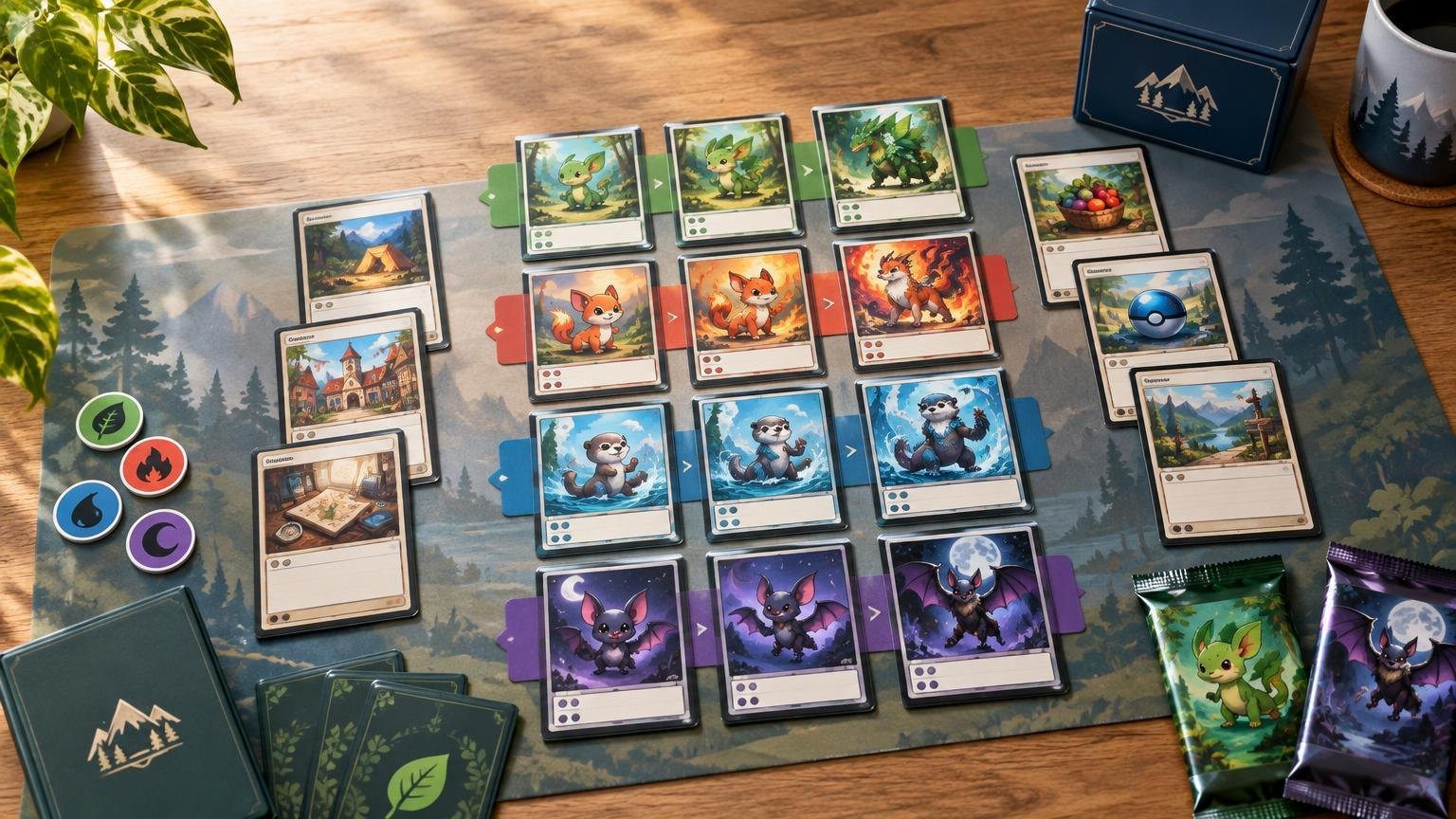
TLDR: A good Pokémon TCG Cube produces functional decks even when nobody drafts perfectly. Its archetypes have enough early Pokémon, Evolution access, Trainer support, Energy compatibility, payoffs, and fallback options to survive contested picks. Intentional duplicates are often healthier than strict singleton design, while repeated drafts and small, measured revisions are more useful than trying to perfect every ratio in advance.
If you are asking what makes a good pokemon tcg cube, the answer is not simply “powerful cards.” A Cube can contain exciting Pokémon and still create stranded Evolutions, unusable Energy costs, and decks that spend several turns doing nothing. The real test is whether players can recognize strategies during the draft, assemble them under imperfect conditions, and play competitive games afterward.
This guide builds on our introduction to building a Pokémon TCG Cube by concentrating on card-pool design and diagnosis. The objective is not to prescribe one universal Cube size or ratio. It is to give you a framework for deciding whether your particular environment works.
Start with a clear Cube contract
Before selecting cards, write down the rules of the environment. This “Cube contract” prevents individual card choices from quietly pulling the project in incompatible directions.
- How many people should the Cube support?
- How will cards be distributed or drafted?
- How many cards will players put in their decks, and how many Prize cards will games use?
- Which eras, sets, mechanics, or themes are eligible?
- Will Evolution follow ordinary rules, use seeded packages, or use a documented house rule?
- Is Basic Energy supplied after the draft?
- Are duplicates allowed, and for which card roles?
- What is the intended power ceiling and typical pace of a game?
Official Prerelease play provides one possible limited-play reference point: 40-card decks, Basic Energy supplied to players, and four-Prize games. Those procedures can be useful inspiration, but they are not mandatory for a private Cube. Play! Pokémon’s Prerelease guidelines explain that official structure.
Calculate the minimum card pool from your draft procedure: number of players multiplied by cards drafted per player. Then add only as much flexibility as your chosen draft method needs. A larger Cube creates variety, but it also dilutes Evolution lines and archetype support. Size should follow the experience you want rather than becoming a target in its own right.
Build archetypes as complete lanes, not equal type piles
Equal numbers of Fire, Water, Grass, and other types do not guarantee balance. One type might contain a complete setup engine while another is a loose stack of unrelated attackers. Design around draft lanes: recognizable packages that can become functioning decks.
Every primary lane needs an early play, a route to its central payoff, compatible Energy costs, enough Trainer support, and a fallback plan. A slower Evolution strategy might need durable opening Pokémon and recovery. An aggressive Basic-focused lane needs enough attackers to start reliably but should not invalidate every slower deck. A discard strategy needs both cards that fill the discard pile and cards that reward doing so.
Avoid making every card useful in only one narrow deck. Include crossover cards that let a player pivot when another drafter contests the same lane. Shared Basics, broadly useful Trainers, colorless attacks, and flexible secondary attackers can all reduce failed drafts without erasing archetype identity.
Evolution access is the central design problem
Under ordinary Pokémon TCG rules, an Evolution is played onto the appropriate earlier-stage Pokémon. That dependency makes an unsupported Stage 1 or Stage 2 much riskier in a draft than a self-contained Basic Pokémon. A powerful final Evolution is not a meaningful pick if the required lower stages are too scarce or disappear into other decks.
There are three practical ways to handle this problem. None is universally correct, but the choice must be explicit.
| Evolution model | How it works | Main tradeoff |
|---|---|---|
| Normal lines | Players draft each stage separately and evolve according to ordinary card requirements. | Preserves familiar gameplay but requires substantial redundancy and careful signaling. |
| Seeded packages | Related stages are bundled, drafted together, or distributed through a separate procedure. | Makes Evolutions reliable but reduces tension around assembling a line. |
| House-rule evolution | A written rule loosens which lower stages can support an Evolution. | Expands draft freedom but changes card evaluation and must be explained before drafting. |
Pokémon’s Alternative Play Handbook offers an official example of this general design space. Its Ditto Draft format uses special markers that allow certain Basic Pokémon to evolve into drafted Stage 1 or Stage 2 Pokémon. It is not a rule every Cube should adopt, but it demonstrates how an explicit alternate system can solve Evolution access. Read the Pokémon TCG Alternative Play Handbook.
If you retain normal Evolution rules, foundational stages usually deserve more redundancy than final payoffs. Branching lines can help because one Basic supports multiple later choices. After every draft, count Evolutions left in sideboards because their earlier stages were missing. Repeatedly stranded cards are evidence of a structural problem, not merely bad luck.
Use Trainers as glue, not filler
Trainers determine whether drafted Pokémon become a deck or remain a pile. Sort Trainer candidates by function rather than by card type or personal popularity.
- Setup and search: helps players find Basics, Evolution pieces, or other required resources.
- Draw: keeps decks moving without making one engine compulsory.
- Mobility: provides switching, retreat support, or ways to escape unfavorable positions.
- Recovery: returns Pokémon, Energy, or key resources without making games endless.
- Interaction: disrupts opposing plans in ways that still leave room for decisions.
- Archetype rewards: improves a specific lane once the general foundation is already sound.
Broadly playable glue should be available before narrow rewards are added. If almost every successful deck requires the same scarce search card, the Cube is testing who opened that card rather than who drafted well. Conversely, too much universal consistency can make every deck feel identical. Generic Trainers should help a strategy function; archetype cards should determine what makes it distinctive.
Treat Energy as an access system
Supplying unlimited or sufficiently abundant Basic Energy after the draft is the easiest starting point. It lets players draft strategies rather than spending picks on basic resources, and it reduces the chance that an otherwise coherent deck fails for administrative reasons. This approach also appears in official Prerelease guidance.
Special Energy can remain in the draft when it creates a genuine decision. It might reward a particular archetype, enable a splash, improve retreat flexibility, or trade reliability for a stronger effect. Remove or replace Special Energy that is an automatic pick for every deck, supports almost nothing, or makes one strategy function while equivalent lanes receive their resources for free.
Energy costs also influence how easily players can pivot. Heavy commitments to one Energy type make lanes less flexible. Colorless requirements and compatible secondary attackers provide escape routes, but too much flexibility can make type identity irrelevant. Decide where your Cube should sit between those extremes.
A good Pokémon TCG Cube does not have to be singleton
Singleton construction is tidy, but Pokémon’s Evolution dependencies make intentional duplicates valuable. Repeating foundational Basics, lower Evolution stages, general search cards, or shared support can improve access without making games repetitive.
Duplicate the cards that help decks begin operating, not merely the cards that end games. Multiple copies of a dominant attacker or universal disruption card can compress the draft around that card. Multiple copies of a modest Basic that supports two branches may instead open several strategies.
Judge duplicates by function. Ask whether another copy increases healthy access, creates repetitive gameplay, or removes a meaningful drafting constraint. For a set-focused environment, the distribution problem is slightly different; our guide to building a Pokémon set Cube covers rarity simulation and set-specific Evolution support.
Run a Cube health check before drafting
Lay out the complete pool by archetype and function. This visual audit often reveals problems that are hard to notice while evaluating cards individually.
- Can every supported lane make an early play?
- Does each Evolution payoff have realistic access to its previous stages?
- Can players pivot when a lane is contested?
- Are Energy requirements compatible with the available support?
- Which cards fit only one deck, and is that deck signaled clearly enough?
- Which cards would almost always be taken first regardless of strategy?
- Does one Trainer engine appear necessary for every viable deck?
- Are there attacks or defensive effects that commonly create non-games?
An automatic first pick is not always a problem. A few exciting cards can give the draft shape. It becomes unhealthy when one card is simultaneously the strongest payoff, the best generic card, and the safest option in almost every opening pack.
Test complete drafts, not isolated games
A Cube cannot be balanced by reading the list alone. Run the full process: draft, build, play, and review. Record repeatable signals instead of letting one dramatic match determine the next revision. That is the same principle used in structured Pokémon proxy deck testing.
Track which cards are picked early, which remain until the end, and which drafted cards fail to make decks. During games, note setup failures, stranded Evolutions, Energy problems, the turn each deck begins making meaningful attacks, and whether the intended archetypes actually appear. Player feedback is most useful when it describes a specific decision or failure rather than simply calling a deck weak.
Change one small package at a time. Add another foundational Basic, replace a narrow Trainer, reduce a dominant payoff, or adjust one Energy requirement. Then repeat the draft. Large simultaneous changes make it difficult to learn which revision solved the problem.
Use proxies appropriately while the Cube evolves
A private Cube is likely to change repeatedly, so inexpensive paper inserts are practical during early testing. Once the list stabilizes and sees regular use, durable full-card playtest pieces may be more convenient; our comparison of paper inserts and full-card proxies explains the handling and revision tradeoffs. Keep unofficial cards clearly identifiable and agree on their use with the playgroup.
Private Cube rules do not replace organized-play policy. Play! Pokémon events operate under separate tournament documents and card-legality requirements, so a casual proxy Cube should not be treated as an event-legal deck pool.
The best next step
A good Pokémon TCG Cube is a system of connected opportunities. Start with a written Cube contract, build complete archetype lanes, and solve Evolution access before adding spectacular final-stage Pokémon. Supply dependable Trainer and Energy foundations, use duplicates where they improve access, and test the whole drafting experience.
For the next draft, track just three things: stranded Evolutions, cards that never enter decks, and picks that every player considers automatic. Those signals will usually identify the first package worth changing—and improving one package at a time is how a promising card pool becomes a Cube people want to draft again.