
TLDR
Good Pokémon proxy product photos should show the physical card from several useful angles, not merely present attractive artwork. Look for readable closeups, front and back views, edge and corner shots, changing light across holographic surfaces, a scale or sleeve reference, and multiple cards from the same batch. Treat a flawless straight-on image as evidence of the design only until the seller demonstrates that it is a photograph of the finished product.
Start by asking whether the image shows a real card
A digital mockup can tell you what artwork the seller intends to print. It cannot show the cut, stock, coating, foil behavior, surface texture, corner shape or actual color reproduction. That distinction matters because an excellent design file can still produce an uneven physical card.
Mockups are not inherently deceptive when they are labeled clearly. The problem is mistaking one for evidence of manufacturing quality. Be cautious when every image is perfectly square, every border is mathematically identical, the card has no visible thickness, and the foil effect looks like a smooth digital gradient rather than reflected light.
A real product photograph will usually reveal some physical context: a hand, tabletop, sleeve, shadow, card stack or changing reflection. Scans and edited composites can also be useful for checking layout, but sellers should identify them instead of letting buyers assume they are photographs.
Demand closeups that reveal printing quality
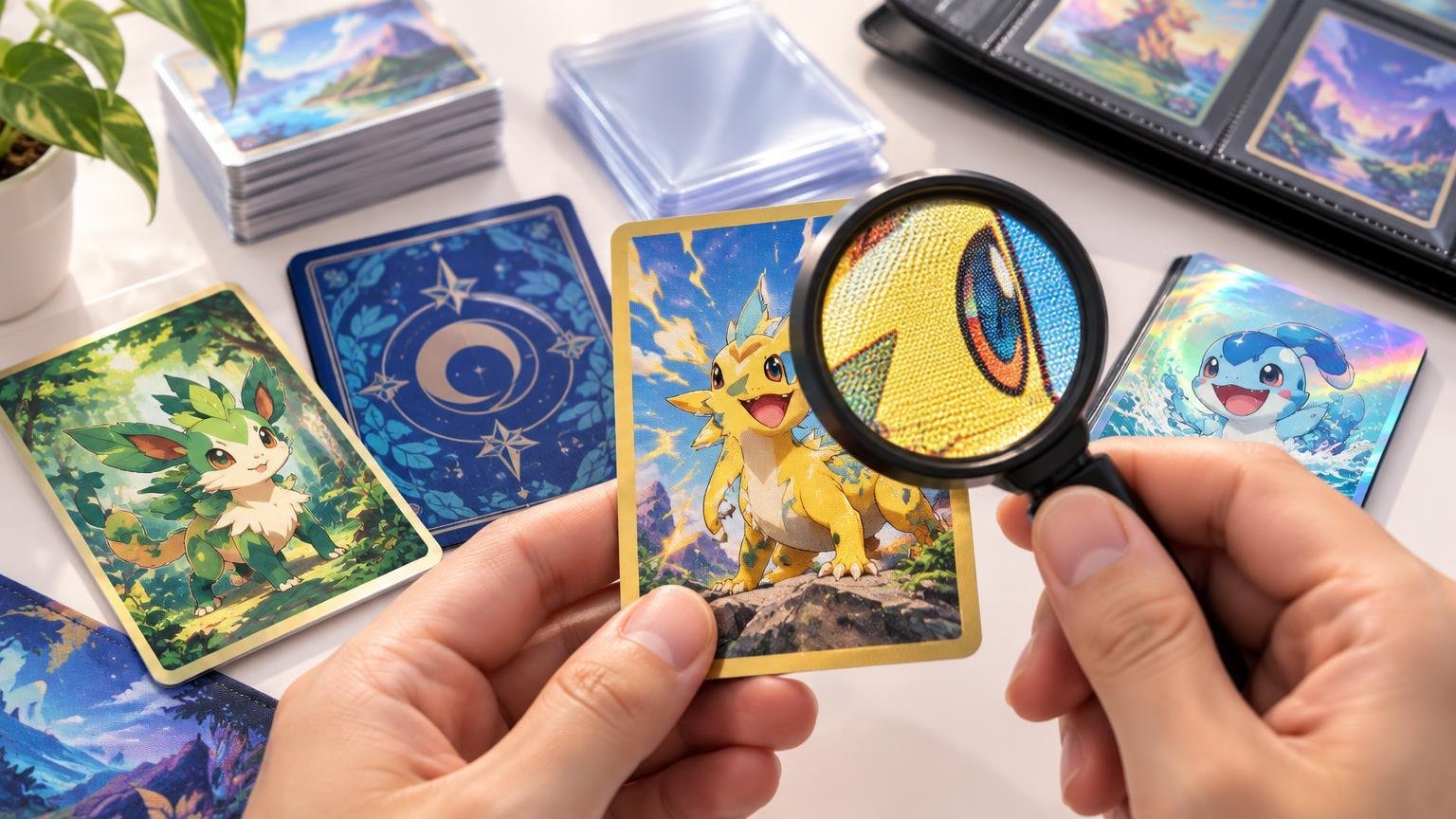
A full-card image is useful for judging the overall composition. Zooming that image until it turns into a blurry collection of pixels is not the same as receiving a proper closeup. Useful detail shots should make small text, Energy symbols, thin lines and dark artwork areas inspectable. They can expose soft text, color fringing, printing halos and lost shadow detail.
Border balance is another quick signal. Compare the space around the artwork and text box on all four sides. An off-center design may come from the source file or the trimming process, but either way it affects the finished appearance. If the listing includes several cards, check whether the same alignment problem repeats.
Inspect edges, corners and the back
Edge photographs are less glamorous than hero shots, which is precisely why they are valuable. Look for rough fibers, burrs, dents, peeling layers, uneven trimming and corners that vary from card to card. A slight side angle can also reveal whether the card lies flat or has noticeable curl.
The back should be shown whenever it is relevant to the product. This helps you understand whether the card is clearly distinguishable as a proxy or custom piece and whether the reverse printing is centered and sharp. Our guide to the difference between a Pokémon proxy and a fake card explains why transparent presentation matters when unofficial cards enter a collection.
Photography alone cannot authenticate a card. Pokémon Support notes that some counterfeit cards are unusually easy to see through under bright light and recommends becoming familiar with official product imagery or consulting a specialized local card shop when counterfeit merchandise is suspected. Read Pokémon Support’s counterfeit-card guidance. That is a separate question from whether a clearly disclosed proxy is printed well.
Holographic cards need several lighting angles
A straight-on photo can show layout and readability, but it provides little evidence about reflectivity, glare or surface evenness. For a holographic proxy, look for several still images under different angles or a short video in which the light moves across the card.
Changing angles can reveal foil coverage, cloudy patches, seams, trapped debris, silvering near the edges and areas that reflect much more strongly than the rest. One carefully chosen angle may hide all of those issues. It may also make an ordinary glossy coating look more dramatic than it appears during normal handling.
After delivery, holographic surfaces need sensible handling because scratches and pressure marks can become conspicuous under direct light. The guide to protecting holographic and custom Pokémon proxy cards covers sleeves, storage and handling after the photo-checking stage.
Look for scale and practical fit
A ruler, familiar sleeve or authentic card placed beside the proxy can provide a useful scale reference. A photo cannot establish exact dimensions or production tolerances, but it can reveal an obviously undersized card, an oversized cut or a poor sleeve fit.
The strongest sleeve demonstration shows the proxy entering the same sleeve as a familiar comparison card without forcing, buckling or leaving an unusual gap. If uniform handling matters for a casual deck or Cube, consistency across the batch is more important than one card fitting perfectly.
One beautiful sample does not represent a batch
A hero image shows the seller’s chosen example. A spread of five, ten or more physical cards gives you more evidence about repeated centering, corner shape, color, foil coverage and trimming. Multiple cards from one order are therefore more informative about batch consistency than one showcase card.
This matters even more for a deck project. Official Pokémon deckbuilding guidance specifies exactly 60 cards for a constructed deck, so a complete proxy testing deck needs consistent handling across many cards rather than perfection in one display piece. Pokémon’s official deckbuilding introduction explains the 60-card structure. If you are assembling a test list, the next practical step is learning how to tune a deck with proxy testing rather than judging cards only as isolated collectibles.
What each photo can actually prove
| Image type | Useful evidence | What it cannot establish |
|---|---|---|
| Straight-on front | Layout, general color and readability | Foil behavior, thickness or edge quality |
| Macro closeup | Text sharpness, fine lines and print artifacts | Whole-card centering or batch consistency |
| Edge and corner shot | Visible fibers, dents, peeling and trimming | Exact thickness or cut tolerance |
| Angled holo photo or video | Reflection, coverage and obvious surface variation | Long-term durability |
| Back photo | Reverse design, disclosure and print alignment | Stock composition |
| Group photo | Consistency across several samples | Whether every delivered card will match |
| Sleeve or scale comparison | Approximate fit and practical handling clues | Certified dimensions |
Use a simple pre-order photo checklist
- Confirm whether each image is a physical photo, scan, render or digital mockup.
- Find at least one sharp closeup of text, symbols, borders and dark artwork.
- Check the front, back, edges and corners where those features matter.
- For holo products, look for several lighting angles or a moving-light video.
- Compare multiple cards rather than relying on one selected hero sample.
- Look for a ruler, sleeve or familiar card as an approximate scale reference.
- Read the description for clear proxy or custom-card labeling instead of assuming visual similarity establishes authenticity.
- Ask whether the pictured sample represents the current production batch if consistency is important.
Treat photos as evidence, not a guarantee
The best listing gallery reduces uncertainty by showing the finished object honestly. It still cannot prove exact stock composition, durability, dimensional tolerance or how every card in an order will look. Seller terms such as “premium” and “black core” are specifications or marketing claims unless they are backed by useful measurements or observable evidence.
The practical rule is simple: reward listings that make imperfections possible to see. Real closeups, unflattering edge shots, changing light and multiple samples are more useful than a flawless floating card image. If the photos only prove that the artwork file looks good, assume the physical print quality remains an open question until the seller supplies better evidence.