
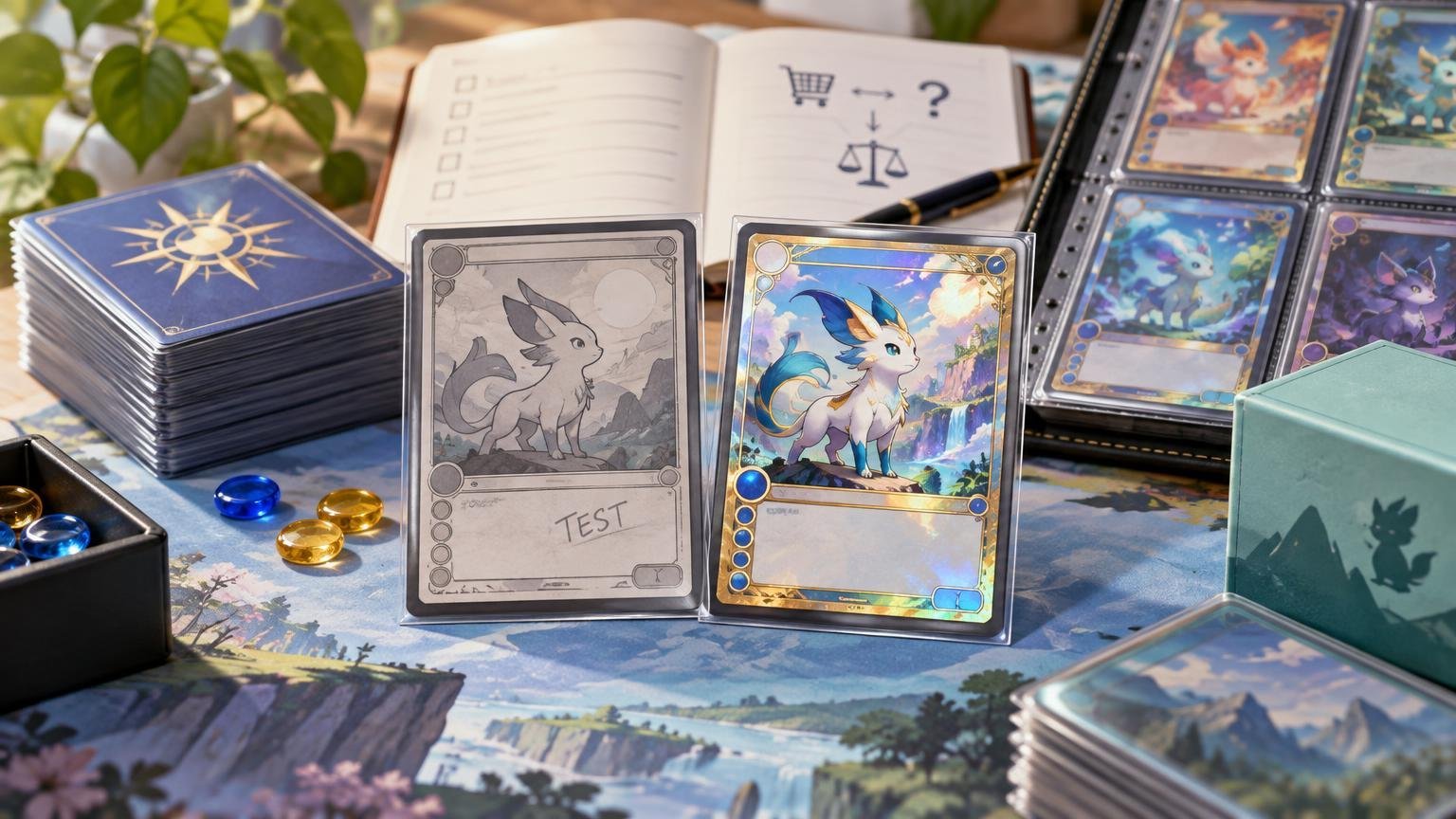
TLDR
Buy the genuine card when its role and copy count feel settled, you expect to play the deck regularly, and the card has enough legal life or casual utility to justify its price. Buy sooner if you are preparing for an official event, because player-made proxies are not permitted in Play! Pokémon events. Keep testing when the card is still matchup-specific, frequently cut, awkward in your opening hand, or competing with another option. There is no magic number of test games.
A proxy should answer a purchasing question
Proxy testing is useful because it turns “this card looks strong” into a more practical question: “Does this exact deck need this card, and how many copies does it need?” If you are still at the beginning of that process, use a structured Pokémon proxy deck-testing routine before spending money.
Pay attention to setup consistency, recovery after disruption, repeated enjoyment, sequencing and useful copy count. A fourth copy has not earned a purchase merely because the deck list allows four; it should improve access or recovery enough to matter. Conversely, a costly one-of can be worth buying if it repeatedly enables the deck’s central plan. Constructed Pokémon TCG decks contain exactly 60 cards and generally allow no more than four cards with the same name, excluding Basic Energy, but the legal maximum is not automatically the correct number for your list. The Play! Pokémon Tournament Rules Handbook explains these deck-construction requirements.
Buy when you are confident in the slot, not after an arbitrary game count
Ten games can reveal an obvious problem, while dozens of games may still leave a close decision unresolved. Matchup variety, the quality of your draws and whether you actually used the card’s intended effect matter more than the raw total.
The slot is probably ready for a genuine copy when you can explain all three of these points clearly:
- The card has a specific job in the deck rather than appearing only because another list used it.
- You have seen that job matter across realistic games, including awkward starts or disrupted board states.
- You know whether the deck needs one copy, a small package or the full count.
Keep proxying when the card regularly sits dead in hand, only helps in a narrow matchup you rarely face, or gets removed whenever you revise the list. Those results do not necessarily make the card bad. They show that it has not yet justified a purchase for this particular deck.
Expected play frequency changes the value calculation
A card for your weekly deck has more opportunity to earn its cost than an equally expensive card in a list you expect to play twice. Before buying, estimate how often you will realistically bring out the deck over the next few months.
| Expected use | Practical approach |
|---|---|
| Frequent local or home play | Buy once the role and count are stable, provided the price fits your budget. |
| Occasional casual play | Consider buying the essential engine while continuing to proxy replaceable or expensive flex slots. |
| Several casual decks share the card | One genuine copy may be enough if you move it between decks and rebuild each deck correctly when required. |
| Mostly experimental use | Keep testing until the deck itself has earned a longer-term place in your collection. |
| Official event planned | Acquire genuine legal copies early enough to confirm the final list and card condition. |
If one expensive card rotates among several casual decks, a clearly organized system can reduce unnecessary duplicate purchases. The key is to track where the original belongs and use clearly identified substitutes across your other casual decks, then assemble the correct authentic list before sanctioned play.
Official-play plans create a firm deadline
Premier Events can also use deck lists and deck checks to verify legality, confirm that the physical deck matches the submitted list and identify marked-card problems. That makes your event date the hard stop for proxy testing. Purchase or borrow permitted genuine copies before final practice so you can verify the exact list, sleeves and card condition rather than changing components at the last minute.
Check the card’s format horizon before paying
A perfect test result can still lead to a poor purchase if the card is close to leaving the format you intend to play. Standard legality is determined through regulation marks, although an older printing can remain legal when the same card has a currently legal reprint. The official Competitive Pokémon Rules and Formats resource provides the current format guidance.
Before buying, use the Pokémon Trading Card Game database to check the card’s expansion and format information. Then consider what happens after rotation. A card with a short Standard horizon may still be worthwhile for an upcoming tournament, an Expanded or casual deck, a Cube, or a collection project. If none of those uses appeal to you, continued proxy testing or choosing a cheaper alternative may be smarter.
Let price determine the required confidence
The more expensive the purchase, the stronger the evidence you should demand from your own games. A low-cost staple that fits several lists needs less deliberation than a costly card that serves one narrow archetype. If you are deciding which purchases deserve the most testing, start with the framework for expensive Pokémon cards to proxy before buying.
Price should also affect copy count. You do not need to buy a full playset simply because you tested four copies initially. Try reducing the count by one and observe whether setup, recovery or sequencing suffers. If the deck behaves the same, the smaller purchase may be enough. If consistency drops in ways that cost games, the additional copy has a practical case behind it.
Use a simple buy, wait or skip decision
| Decision | What it looks like |
|---|---|
| Buy | The role is proven, the count is stable, you expect regular use, legality suits your plans and the cost fits your budget. |
| Wait | The deck works, but the copy count, rotation horizon, event plans or price still need clarification. |
| Skip | The card is often dead, easily replaced, attached to a deck you do not enjoy or unlikely to see meaningful play. |
“Wait” is a useful result, not a failure to decide. It can mean testing a cheaper card in the same role, watching whether the deck survives a format change, or setting aside money without disrupting higher priorities. A proxy lets you preserve that flexibility without pretending the purchase is already justified.
The right time to buy
Stop proxying and buy the genuine copy when the card has moved from interesting possibility to dependable deck component. You should know what it does, how many copies improve the list, how often you will use it, where it is legal and why it deserves room in your budget.
Buy earlier when an official event creates a real deadline. Wait longer when rotation is close, the deck is still changing or the card’s job remains vague. The goal of proxy testing is not to reach a predetermined game count. It is to make the eventual purchase feel informed rather than hopeful.